


The 12th Congress of the International Vegetarian Union, Holland 1950
From the Vegetarian Messenger, (Manchester) :
THE 12th CONGRESS OF THE INTERNATIONAL VEGETARIAN UNION - HOLLAND.
THE 12th Congress of the International Vegetarian Union was held from the 11th to the 18th July, 1950, at The Pietersberg, Oosterbeek, Arnhem, Holland, under the Presidency of Mr. W. A. SIBLY, M.A.,J.P. (England).
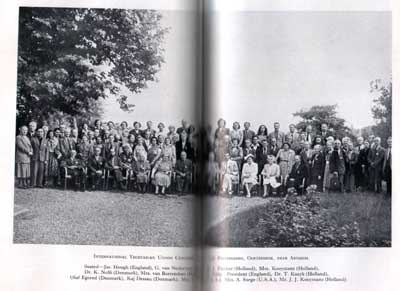
Opening Meetings.
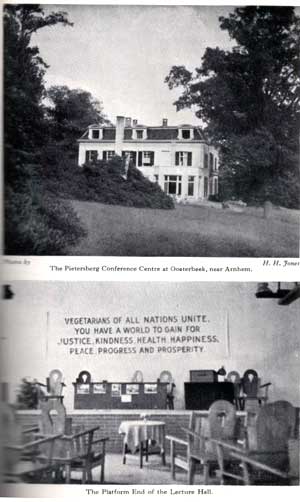 The official
opening of the Congress was signalized by the hoisting of the I.V.U.
banner on the flagstaff in the grounds of "The Pietersberg "
- a conference house in the wooded country at Oosterbeek, a few miles
from Arnhem. Mr. W. J. FISCHER, President of the Dutch Vegetarian
Society welcomed the delegates and friends, and in the course of his
remarks conveyed an apology from Mr. Felix Ortt, the grand old man
of the Dutch Vegetarian movement, for his unavoidable absence. It
was thereupon agreed to send a message conveying the good wishes of
all present.
Mr. SIBLY, as President of the Union, thanked Mr. Fischer and the Dutch Society for their warm welcome to Holland. He felt that in the adoption of vegetarianism lay the best hope for the future mankind, and he expressed the wish that the work of the Congress -during the following days might be a turning point in the history of the Union and an inspiration to all.
Brief speeches were made by delegates from the countries represented. Mrs. Clarence Gasque (U.S.A.), in speaking on behalf the American Vegetarian Union, brought with her a huge banner which was inscribed: "Vegetarians of all nations unite; you have a world to gain for justice, kindness, health, happiness, peace, progress and prosperity."
Mrs. Gasque was followed by Professor Arthur F. Stevenson (Canada), Dr. Edal Behram (India), H. H. Jones (England), G. Henderson (The Vegan Society), Mrs. D. Horsfield (England) A. Reid (Scotland), G. van Nederveen (Holland), N. Nielsen (Denmark), M. Karlson (Norway), J. Pedersen (Sweden), A. J. Perroud (France), and Hans Peters (Youth Movement, Holland).
Mr. Oluf Egerod gave a brief account of the Congresses held during the years between the two great wars.
Messages and greetings were read from the Los Angeles Vegetarian Society and from the President of the American Vegetarian Union (Dr. Gehman).
Reports from Delegates.
Brief reports of work accomplished in the various countries -given
by delegates from America, Canada, Denmark, Gt.Britain, Holland, Norway
and Sweden.
The Hon. Treasurer, Mr. Oluf Egerod, submitted a statement of receipts and payments which was accepted and approved.
In response to a request, the President, Hon. Treasurer, and the Hon. Secretary reported upon work which they had done on behalf of the Union since the last Congress.
Applications for Membership.
The following applications for membership of the International Vegetarian
Union were confirmed: (1) American Vegetarian Union, (2) Canadian
Vegetarian Union; and after discussion of their respective claims,
which complied with the rules of the I.V.U., the applications for
admission from (3) The Vegetarian Catering Association (Gt. Britain),
(4) The Vegetarian Union (Germanv)-(Secretary Mr. H. Rall, Schwarzwald)
-were also accepted. The question arose as to the eligibility for
membership of the Vegetarier Union Deutschland (V.U.D.) Although no
application had been made for affiliation it was agreed that Mrs.
A. Sorge, when in Germany, be asked to investigate and report upon
this Society, and that if her report be favourable the V.U.D. should
be accepted as a member on receipt of its official application. The
hope was expressed that the various societies in Germany might ultimately
unite into one union for purposes of I.V.U. representation.
Election of Officers.
The officers of the I.V.U. were elected as follows--President: W.
A. Sibly, M A. (Gt. Britain), Vice-Presidents: Mrs. Clarence Gasque
(U.S.A.) and James Hough (Gt. Britain), Hon. 'Treasurer: J. Pedersen
(Sweden), Hon. Secretary: Oluf Egerod (Denmark), Acting Secretary:
H. H. Jones, BA. (Gt. Britain).
The President announced that through the generosity of Mrs Gasque it would be possible for the I.V.U. to appoint a paid Secretary, with Headquarters in Gt. Britain,* and that such an appointment would be made by the officers of the Union by the end of 1950.
(*The Headquarters were sanctioned in Gt. Britain on account of the present difficulties in transferring currency from one country to another.)
A further offer was made through Mr. Nederveen (Holland) of the use of an institute in Holland for purposes of scientific and cultural research, and this was gratefully accepted.
Lectures.
Despite a full programme of business meetings, there were no fewer
than eight lectures. The first lecture was given by the President,
Mr. W. A. SIBLY, MA. (Great Britain) who described, with lantern illustrations,
his recent visit to Australia and New Zealand. By means of a remarkably
fine series of slides, taken from his own photographs, Mr. Sibly imparted
much of the atmosphere in various parts of Australia and New Zealand,
interspersed with the many personal contacts he had made among vegetarians
and others two countries.
The address of Dr. KIRSTINE NOLFI (Denmark) is printed on page 232, and Dr C. J. SCHUURMAN'S lecture on "The Psychology of Vetarianism : Relation between Parents and Children," Will appear in our next issue.
Mr.H. A. M. C. DIBBITS (Holland), a Dutch engineer, gave a most interesting lantern lecture on the history of the "Dutch Polders". His address made one feel What a Herculean task his countrymen had faced When they first planned the reclamation of those regions which, even within comparatively recent times, were under water.
Mr. KAJ DESSAU (Denmark), in a vigorous call to action, spoke of "The Future of the International Vegetarian Movement." His address will be fonnd on page 261 of this issue.
Mr. ROY WALKER (Great Britain) lectured on "The Coming World Famine." This address is obtainable in pamphlet form under the title of Bread and Peace." (*Price ½, post free. From The Vegetarian Society).
Mrs. CLARENCE GASQUE (U.S.A.) said that she did not recognize n-ations as such-she was more concerned with human life and with whatever was noble-in that she was interested. She referred to the many phases of our vegetarian philosophy-humanitarian, economic, psychological, physiological, health, philosophical, religious, no less than the important aspect of the treatment-or maltreatment--of the soil. Speaking of America, she said that the advertizing companies required to he called to a halt : they were "psuchologizing" the human mind, and had reached a stage which made her refrain from turning on her radio. She described an incident in Kashmir in which the carrots, potatoes and other garden produce had been grown on foul land, and where it was necessary to cleanse the soil before the vegetables were fit to eat. If this were done, she said, the soil could live naturally and healthily, and nature would be certain to give her best in return. Mrs. Gasque stressed the great importance of demonstrating vegetarian meals. She had, herself, done much in that direction but she made it clear how vital it was to present those dishes in a nice and attractive form, and how necessary it was for us to be reasonable in our approach, other-wise we should never get adherents to our cause.
Mrs. Gasque concluded, as she had begun, on a high level, emphasizing the fact that our object as vegetarians was to ascertain our relationship with life at every stage.
Dr. Voute (Holland) gave a most interesting illustrated talk on the "Biological Equilibrium." It was a valuable contribution to the lecture programme despite the fact it contained little of a vegetarian character. Nevertheless it was a subject about which vegetarians were invariably questioned and asked for a categorical answer despite the fact that such an answer might be as obscure as the origin of the universe itself.
Dr. Voute said that it was mainly carnivorism which was responsible for the equilibrium in nature and he gave many illustrations to show how one type of animal or insect preyed upon another. He said that the dormouse and the caterpillar were far more dangerous to man than such animals as the lion, and he described very fully the life cycle of the ichneumon fly which required "live" food for its sustenance. A further very practical aspect of Dr. Voute's lecture was his statement to the effect that the more intense the application of insecticides, the more unstable was the biological equilibrium. Many insects, he said, were able to develop immunity from insecticides.
An interesting discussion followed during the course of which Dr. Voute declared that in certain instances of an unbalance of nature, and where there was an obvious lack of food, it was more humane to shoot some animals rather than allow them to die from starvation.
Informal Discussion.
Although not included in the programme of the Congress, Mr. G. Allan
Henderson led an informal discussion on the vegan aspect of vegetarianism
on the Sunday morning.
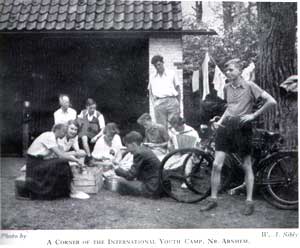 Youth
Camp.
A delightful and progressive feature of the Congress was the Youth
Camp, which was attended by representatives from Belgium, Denmark,
England, Germany, Indonesia, the Netherlands, and Switzerland. So
successful was this venture that it has been decided to hold an International
Youth Camp, in Germany, during the Summer of 1951. A notice of this
will be found in our advertise-ment columns.
Resolutions.
The following resolutions were accepted by the Congress for circulation
throughout the world:
WORLD FOOD CRISIS.
Knowing that "it is possible to construct diets meeting all known
nutritional requirements on the basis of whole-grain bread, fruits,
vegetables and milk " (Food, Famine, and Relief, League of Nations,
Geneva, 1946) and having found by long experience that such diets
can be more natural, health-giving and appetizing, the vegetarians
of three continents, gathered at this Twelfth Congress of the International
Vegetarian Union in Holland, urgently appeal for a planned food economy
along these lines, which will avoid the present gross wastage of nine-tenths
of the nutrients fed to live-stock bred only for slaughter; halt the
present destruction of top-soil by over-grazing, and enable the food-producing
land now available to support at full nutritional standards not only
the entire human population of to-day, but also the larger human populations
that will appear within the next hundred years. The Congress believes
that such a food economy, which would require less than one acre per
head, would make the largest contribution immediately to solv-ing
the world food crisis and achieving freedom from want; it affirms
that no other single step could contribute so much as a vegetarian
food economy to the prevention of destructive conflict and war. The
land available for food production is limited and can-not adequately
support even the present world population on a mixed diet, which requires
some two acres per head. There can be no speedy solution to the world
food crisis without a drastic reduction of live-stock and a consequent
large increase in the culti-vation of food for direct human consumption.
Drafted by Roy Walker (London)
and H. H. Jones (Manchester).
COMPOST AND SOIL FERTILITY.
That this 12th Congress of the International Vegetarian Union, realizing
that continual application of artificial fertilizers to the world's
farmlands is uneconomic and has a drying effect on the soil which
in time will seriously reduce the cropping area and cause erosion,
calls upon Governments and Agricultural Associations encourage the
making of compost from garden and kitchen waste which will supply
humus cheaply, and thereby increase the moisture -content and fertility
of the land.
(Mrs. Margaret Horsfield, London).
YOUTH ORGANIZATIONS.
"That the youth of each Society shall be encouraged to formulate
their own individual organization, to study their own ways means,
aims and problems, and that they shall keep in close touch with the
senior organization which will assist, guide, and protect them in
the fulfilment of their aims."
HUMANE SLAUGHTER.
That until all the peoples of the world become vegetarian, the International
Vegetarian Union urges individual vegetarians everywhere to endeavour
to minimise the animal suffering involved in the meat trade by supporting
campaigns for the introduction of humane methods of slaughter, by
joining organizations working towards that end, and by any other means
at their comnand." -Vegetarian Societies will continue to offer
uncompromising resistance to all forms of slaughter of animals for
food.
VEGETARIANISM IN THE FORCES.
"That representation should be made to all national Governments
requesting that provision should be made to enable vegetarian soldiers,
sailors, and airmen to maintain their fleshless regimen.
(Professor A. F. Stevenson, Canadian Vegetarian Union)
Excursions.
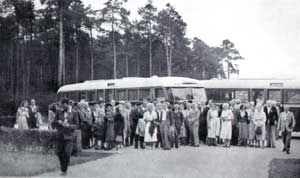 Our
Dutch friends were very anxious that visitors from other countries
should see something of the Netherlands during to the Congress. Two
major excursions were planned as well as a final excursion to the
Zuider Zee Dyke and Volendam.
Rotterdam was the venue of the first visit, reached by skirting Utrecht and by way of Gouda. A delightful steamer trip through the harbours preceded a welcome break for refreshments and a glance at the Exhibition to celebrate the rebuilding of the port after the recent war devastation. Leaving via the Maas Tunnel, the area around Elshout, with its 22 windmills, was explored and described by Mr. Dibbits whose lecture the previous evening made this excursion all the more interesting.
 During
the afternoon of the closing day of the Congress the district containing
the National Park of the Netherlands (De Hoge Velurve) presented another
side of Dutch life. The park covers approximately 13,600 acres, and
although a small portion of this is cultivated the greater part constitutes
a nature preserve where among the many birds and animals, we caught
sight of the red deer as we passed along its thickly wooded avenues.
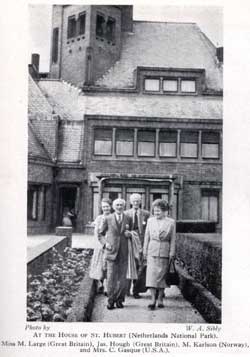
Two buildings of note are situated in the Park-The House of St. Hubert,
designed by the architect Berlage in 1913, to symbolize the legend
of St. Hubert, and the Kröller-Müller Museum which, in addition
to paintings and sculpture by many well-known artists, contains the
largest collection of the works of Vincent van Gogh.
Other visits in the vicinity of Arnhem were made to the Open Air Museum, and to its Exhibition, and to the Vegetarian Home for Aged People, at Oosterbeek, the organization of which was excellently described by Mr. J. H. Bolt to an interested audience.
Farewell Dinner.
At the concluding session Mr. Sibly, said that the Congress had been
a very successful and happy one and that it had been distin-guished
for the first time by the presence of delegates, as distinct from
visitors, from North America and Canada. He referred to the Youth
Camp which had been organized in conjunction with the Congress, and
thanked the staff of The Pietersberg and our Dutch friends for their
work in organizing the Congress and for their hos-pitality during
the course of the week. Mr. Sibly was followed, in his expression
of thanks to our Dutch hosts, by Mrs. Gasque (U.S.A.), Prof. Stevenson
(Canada), Mrs. Nielsen (Denmark), Jas Hough (Gt. Britain), H. Rall
(Germany), Dr. Edal Behram (India), A. Tee Boan An (Indonesia), Dr.
H. J. Rogler (Norway) and J. Pedersen (Sweden). Mr. O. Egerod (Denmark)
also spoke, and the representatives of the Youth Movement invited
all vegetarians to join the Youth Camp to be held in Germany in 1951.
Mr. G. VAN NEDERVEEN (Holland), in replying on behalf of the Dutch Vegetarian Society, said how glad they were in Holland that we had visited their country. The future, he said, belonged to youth and the more we could encourage young vegetarians the better it would be for our cause. Dr. T. Kaayk, who had also done so much towards the success of the Congress, briefly responded.
Mr. HANWORTH WALKER (Gt. Britain), in response to a
request from the President, briefly outlined the excellent work which
was being done at the Vegetarian Home for Children, at Rainhill, near
Liverpool. He said they had been criticized for not being sufficiently
practical. Their whole life, where they were working with non-vegetarian
doctors, schools, etc., was an answer to this charge. If they were
to be judged by the spirit which was put into their work then they
would not be disappointed, for in the Vegetarian Movement
were the foundations of the brotherhood of man and the lasting peace
of the world.
- Hits: 670