


Timeline of Vegetarian History - The Ancient World
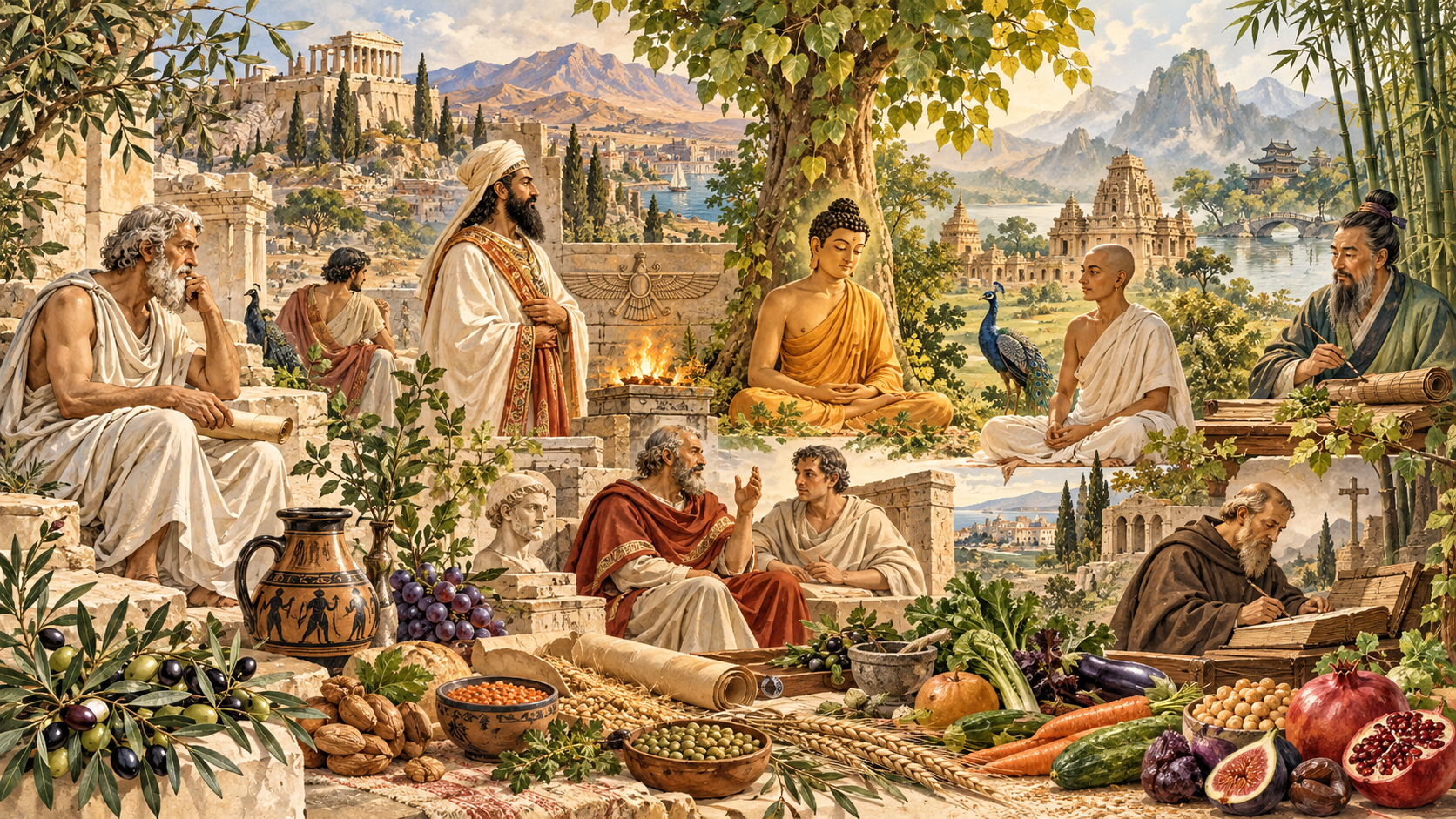
Timeline of Vegetarian History - The Ancient World
Note - it is not claimed that everyone on this page was a strict vegetarian! But they often had interesting views that are relevant to the wider issues.
Before the timeline – background reading
Omnivorous or Vegetarian?
What famous naturalists think about it. by Professor Luis Vallejo Rodríguez (EVU News 1996)
- Deutsch Allesfresser oder Vegetarier? – Was berühmte Naturforscher darüber denken
- Español Omnívoros o Vegetarianos? – Lo que algunos naturalistas famosos piensan sobre esto
- Français Omnivore ou Végétarien ? – Ce qu'en pensent des naturalistes célèbres
Vegetarianism and Archaeology
by Derek Wall, B.Sc (The Vegetarian, UK, 1988)
What Did Our Ancestors Eat?
(personal file 1994)
- Español ¿Qué comían nuestros ancestros?
Native Americans and Vegetarianism
(Vegetarian Journal 1994)
Traditions & overviews

Hebrew Religion of Israel
(World Vegetarian Congress 1957)
- Judaism and Vegetarianism Ted Altar (c.1994)
- Is there a basis in Jewish Ethics for Mandatory Veganism or a Humane Farm Animal Diet – Phineas Leahy 2003
- The Vision of Eden: Animal Welfare and Vegetarianism in Jewish Law and Mysticism (book review 2003)
Animal Minds and Human Morals
– book review dealing with early Greek and Christian philosophies.
Vegetarianism 8th century BC to 5th century AD
(IVU World Vegetarian Congress, India, 1957)
- Hesiod
- Pythagoras
- Cyrus the Great
- Herodotus
- Empedokles
- Plato
- Ovid
- Cicero
- Seneca
- Plutarch
- Tertullian
- St. Clement of Alexandria
- Porphyry
- St. Basil the Great
- St. Jerome
- St. Augustine
- Chrysostum
800 BC – 470 BC
Prophets, Sages & First Philosophers
Hesiod and Zoroaster, Mahavira and the Buddha, Pythagoras and the Orphic communities.
- 800 BC
Greece
Hesiod
(c. 8th century BC)
- 628 BC
 Persia
Zoroaster / Zarathustra
(628?-551?BC)
- Español Zoroastro
- 604 BC
 China
China & Vegetarianism
a personal view by Ting Jen, Indonesia (c.2001)
- 599 BC
 IndiaJainism
Mahavira
(599-527 BC)
founder of Jainism
- Dietary code of practice amongst Jains (WVC 2000)
- Italiano Il canone alimentare dei Jainisti
- Glimpse of the Fabulous Jains (World Forum 1956)
- Jainism (World Congress 1957)
- Teaching of Jainism (World Congress 1957)
- PDF7mb
Outlines of Jainism by Jagmanderlal Jaini M.A., Indore. Pub. Cambridge, 1916. - PDF7mb
The Kalpa Sutra, and Nava Tatva: two works illustrative of the Jain religion and philosophy trans. & appendix by J. Stevenson, Bombay. Pub. London, 1818 - PDF22mb
Jaina Sutras Part I trans. Hermann Jacobi, Oxford 1884 (reprinted India 1964).
- Dietary code of practice amongst Jains (WVC 2000)
- 580 BC
 Greece
Pythagoras
(?580-?500 BC)
- Pythagoras – from The Ethics of Diet, by Howard Williams 1883
- 563 BC
 Buddhism
Buddha
(?563-483 BC)
– vegetarian?
- Italiano Budda (?563-483 a.C.) - vegetariano?
- Español Buda
- Magyar Buddha (?563-483 BC) - vegetarianus?
- Sakya Muni/Siddartha/Buddha – from The Ethics of Diet, by Howard Williams 1883
- Did Lord Buddha Countenance Meat Eating? (IVU World Vegetarian Congress, India, 1957)
- Buddha and Vegetarianism - the path to non-violence – as above
- A Buddhist Perspective on Vegetarianism (personal view, 1995)
- A Buddhist View of Vegetarianism (personal view, c.2001)
- Jon Wynne-Tyson on Buddha/Buddhism (Food for a Future, 1975)
- PDF9mb
Texts from the Buddhist canon, commonly known as Dhammapada, with accompanying narratives trans. Samuel Beal, Prof. of Chinese, London, 1878. - PDF9mb
The Lankavatara Sutra; a Mahayana text trans. Daisetz Teitaro Suzuki, London, 1932
- 540 BC
 Greece
Orphic Communities
(c540 BC - ?)
- Italiano Comunità orfiche
- 520 BC
Persia
Cyrus the Great
(c.520BC)
- 484 BC
Greece
Herodotus
(484-425BC)
- 480 BC
Greece
Empedokles
(?480-430BC)
- Empedokles – from The Ethics of Diet, by Howard Williams 1883
- PDF5mb
The Fragments of Empedocles trans. W.E. Leonard Ph.D., Chicago, 1908.Part 2 refers to transmigration of souls and the Orphic/Pythagorean traditions.
- 470 BC
 Greece
Socrates
(?470-399 BC)
445 BC – 5 BC
Classical Greece, India & Rome
Plato and the Greek schools, King Asoka, the Hindu tradition, and the Roman voices of Cicero, Ovid and Seneca.
- 445 BC
Greece
Antisthenes
(?445-365 BC)
- 427 BC
Greece
Plato
(?427-?347 BC)
- Plato – from The Ethics of Diet, by Howard Williams 1883
- PDF7mb
Plato's Republic trans. Lewis Campbell M.A., LL.D., London, 1902.In Books II & III develops the dietary ideas of Pythagoras.
- 412 BC
Greece
Diogenes
(?412-?323 BC)
- Italiano Diogene
- PDF15mb
The Lives and Opinions of Eminent Philosophers by Diogenes Laertius, trans. C. D. Yonge B.A., London, 1853.Includes sections on Pythagoras, Empedocles, etc.
- 384 BC
Greece
Aristotle
(384-322BC)
- Español Aristóteles
- 372 BC
Greece
Theophrastus
(?372-?287BC)
- 341 BC
Greece
Epicurus
(341-270BC)
- Español Epicurus
- 300 BC
 Sri LankaJapan
-
The Vegetarian Movement in Sri Lanka
(IVU World Vegetarian Congress, 1999)
-
Vegetarianism and Vegetarians in Japan
(IVU News, 1998)
- Español El Vegetarianismo y los Vegetarianos en Japón
- Français Végétarisme et Végétariens au Japon
- Indonesia Vegetarianisme dan Vegetarian di Jepang
- Magyar Vegetarianizmus es a vegetarianusok Japanban
-
- 273 BC
India
King Asoka of India
(273?-232 BC)
- Asoka – from The Ethics of Diet, by Howard Williams 1883
- PDF9mb
Asoka, the Buddhist emperor of India by Vincent A. Smith M.R.A.S., Oxford, 1901.Banned all animal slaughter in India.
- 200 BC
IndiaHinduism
Hinduism
"Hinduism has prehistoric roots . . . Classical Hinduism emerges with the decline of Buddhism in India from the 2nd century BC "
- Hinduism (IVU World Vegetarian Congress, India, 1957)
- The Hindu Attitude Towards Vegetarianism (as above)
- Hinduism and Vegetarianism (IVU News, 2000)
- Why Hindus Don't Eat Meat (Himalayan Academy 1993)
- PDF36mb
The Laws of Manu trans. George Bühler, Oxford, 1886.Somewhat disputed Hindu texts... does not prohibit meat eating but: p.174, Law 48: "Meat can never be obtained without injury to living creatures, and injury to sentient beings is detrimental to (the attainment of) heavenly bliss ; let him therefore shun (the use of) meat."
- 106 BC
Rome
Cicero
(106-43 B.C.)
- 43 BC
Rome
Ovid
(Publius Ovidius Naso) (43 BC - AD 17)
- Español Ovidio
- Ovid – from The Ethics of Diet, by Howard Williams 1883
- PDF42mb
Ovid's Metamorphoses This edition pub. London 1822.Book 15, p.516 is a biography of Pythagoras. p.519: 'He first forbid animal food to be served up at the tables of men'.
- 5 BC
Rome
Seneca
(c.5 BC - AD 65)
- Seneca – from The Ethics of Diet, by Howard Williams 1883
- PDF17mb
Seneca's Morals - trans Sir Roger L'Estrange, New York, c.1870.p110: "I gave over eating of flesh"
c.3 BC – AD 354
Early Christianity & Late Antiquity
Apollonius, Jesus and the Essenes, Plutarch, the Neoplatonists and the Church Fathers.
- c.3 BC
Apollonius of Tyana
c.3 B.C. - c.97 A.D.
– from The Ethics of Diet, by Howard Williams 1883
- 1st C
 Christianity
Jesus, the Essenes & the early Church
- Was Christ a Vegetarian? (Ted Altar c.1995)
- Christianity : Jesus was a Vegetarian (World Congress 1957)
- Does meat consumption corrupt the Eucharist? (c.2003)
- Ethics, Christianity and Vegetarianism (European Congress 1997)
- Italiano Etica, cristianesimo e vegetarismo
- Religion & Vegetarianism / Are Christians Vegetarians? (IVU News 1996)
- The Cruelty and Wastefulness of Meat Eating – a Quaker view (IVU News 1998)
- The Golden Age Must Return – A Catholic's Views on Vegetarianism (IVU World Vegetarian Congress 1965)
- The Mass of Christ (Poem 1957)
- The Misrepresentation of Jesus' Directives (Food for a Future, 1975)
- Español La Tergiversación de los Mandatos de Jesús
- Indonesia Kesalahpahaman atas Ajaran yang Diberikan Yesus
- The Essenes (IVU News 1996)
- Español Los Esenios
- Português Os Essênios
- The Way of Jesus the Nazirene or "The Way vs. The Church" – Essenes (IVU World Vegetarian Congress 1996)
- The Early Christian Church – from The Ethics of Diet, by Howard Williams 1883
- PDF52mb
The Ante-Nicene Fathers: Translations of the Writings of the Fathers down to A.D. 325 edited by A. Roberts and J. Donaldson, Vol.2 (of 10 vols.)See: On Eating.
- 1st C
Rome
Gaius Musonius Rufus
(1st Century A.D.)
– from The Ethics of Diet, by Howard Williams 1883
- AD 46
Greece
Plutarch
(c.AD 46-c.120)
- PDF27mb
Plutarch's Morals Vol.5 edited by W. W. Goodwin Ph.D, Harvard, 1878.Includes the essay 'Of Eating Flesh'
- PDF27mb
- 150
Christian
St.Clement of Alexandria
(c.150-215)
- Clement of Alexandria - Titus Flavius Clemens: Died 220 (?) A.D. – from The Ethics of Diet, by Howard Williams 1883
- 160
Christian
Tertullian
(?160-?220)
- Tertullian – from The Ethics of Diet, by Howard Williams 1883
- 205
Rome
Plotinus
(?205-?270)
- Italiano Plotino
- 233
Greece
Porphyry
(233 - 304)
- Porphyry – from The Ethics of Diet, by Howard Williams 1883
- PDF10mb
Select Works of Porphyry: Containing His Four Books On Abstinence from Animal Food; etc. - trans. T. Taylor, London, 1823
- 250
Greece
Iamblichus
(c.250-c.325)
- 330
St.Basil (Bishop of Caesarea)
(330-379)
- 331
Emperor Julian
(331-363)
Flavius Claudius Julianus, also known as Julian the Apostate
– from The Ethics of Diet, by Howard Williams 1883
- 340
St. Jerome
(340-320)
- 347
St.John Chrysostom
(c.347-407)
- Chrysostom – from The Ethics of Diet, by Howard Williams 1883
- 354
St. Augustine
(354-430)
5th Century – 1181
Into the Middle Ages
Christian and Western literature, Islam and Sufism, the Cathars, Maimonides and St. Francis of Assisi.
- 5th C
Christian and Western Literature
5th Century to 16th Century
– from The Ethics of Diet, by Howard Williams 1883
- 570
Islam
Islam
(World Congress 1957)
- Islamic duty of compassion towards animals (IVU News, 1996)
- Sufism (World Congress 1957)
- 1000–1300
The Cathars
(11th - 13th Centuries)
- Français Les Cathars
- 1066
England
Food in England Since 1066 -- A Vegetarian Evolution?
(compiled 1992)
- 1135
Maimonedes (Rabbi Moses ben Maimon)
(1135-1204)
- Español Maimónides
- 1181
St.Francis of Assisi
(1181-1226)
- Deutsch St. Franziskus von Assisi
- Italiano San Francesco d'Assisi
- Magyar Assisi Szent Ferenc
- Hits: 1100