


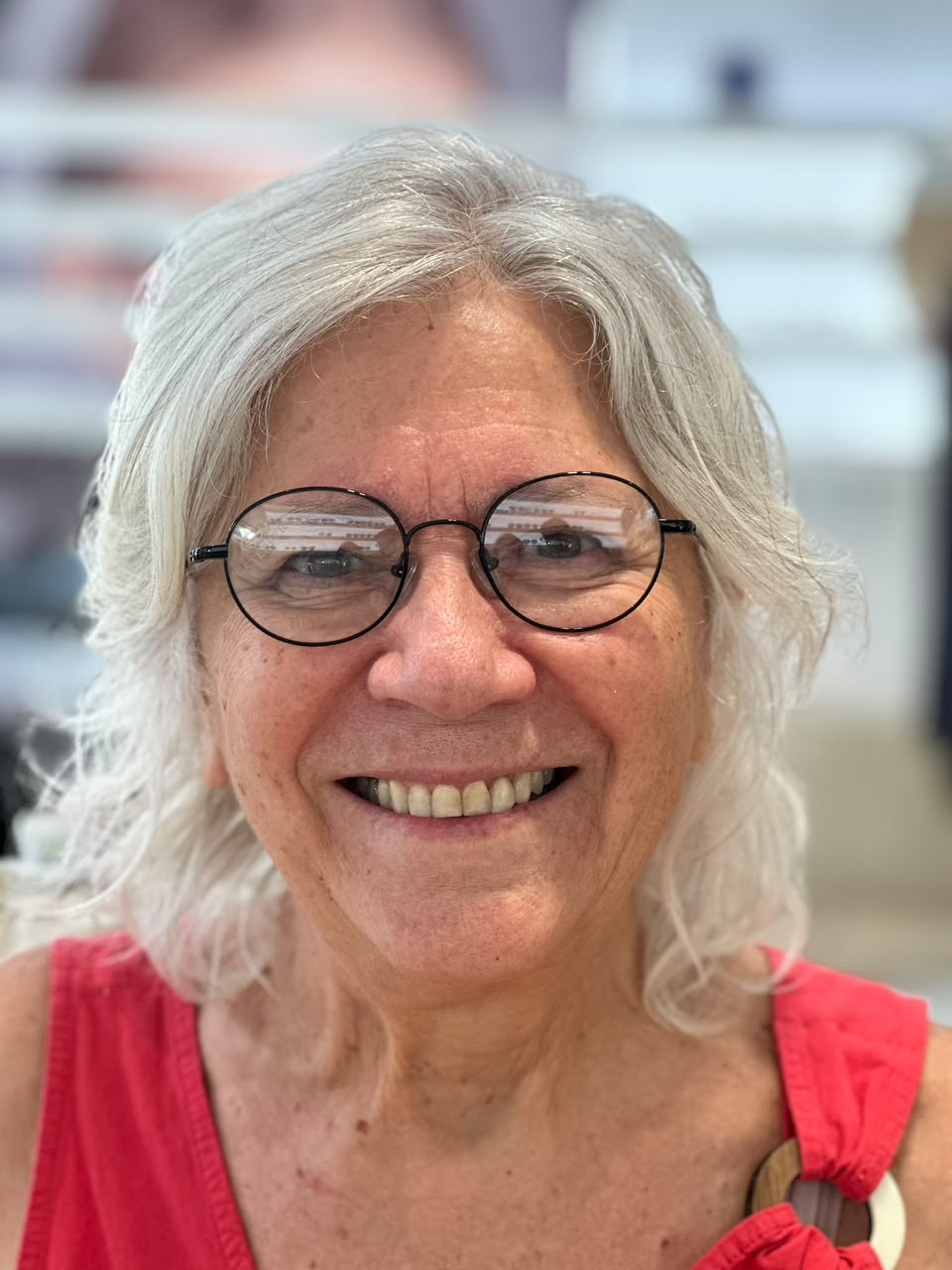
 Marly Winckler
: the sociologist who drew the map of vegetarianism in Brazil
Founder of the Brazilian Vegetarian Society, organiser of the first World Vegetarian Congress ever held in Latin America and Chair of the International Vegetarian Union for a decade, she talks to IVU about three decades of activism, public policy, translation and the future of a movement she helped lift out of the margins.
This interview was first published in Portuguese by Guia Vegano, an IVU member organisation in Brazil. A podcast version is also available.
In November 2004, vegetarians from dozens of countries arrived at Costão do Santinho, in Florianópolis, for the 36th IVU World Vegetarian Congress. IVU had been founded in 1908, and this was the first time its congress had ever been held in Latin America. Few people there knew that making that week possible had required building an entire institution from scratch. The Brazilian Vegetarian Society (SVB) was created in 2003 for that almost logistical purpose — and it is still going today.
Behind both stood Marly Winckler.
She was born in 1954 in Cunha Porã, in the west of Santa Catarina state, in a region of subsistence farming where raising animals for food was part of family routine. She began studying Architecture in Porto Alegre, spent two years in London and also lived in India, and graduated in Social Sciences from UFRGS in 1982. She later took a postgraduate course in Translation at PUC-Rio. She became vegetarian in 1983, drawn by Theosophical thought, and vegan in the mid-1990s, after following IVU's debates in The Hague about serving eggs and dairy at vegetarian events.
She was also a pioneer of the Brazilian internet. In 1997 she created the Sítio Vegetariano, the first website on vegetarianism in the Portuguese language, along with the Veg-Brasil and Veg-Latina discussion lists — at a time when talking about veganism meant exchanging emails over a dial-up connection.
In 2000 she took on the IVU regional representation for Latin America and the Caribbean, a role she held until 2016. In 2011 she became Chair of IVU, serving a first term until 2014 and a second from 2018 to 2025. She also led the SVB from 2003 to 2015. Over that period, working with a structure sustained almost entirely by volunteers, she launched projects that are still running today:
She also took the animal cause to the Brazilian Bar Association (OAB), with two events. The first, in 2013, at the Federal District chapter, was the first event on animal rights ever held within the Bar. Within two years, 14 of the 27 state chapters had their own committees on the subject. The second, in 2015, at the national Bar: the 1st Forum for the Defence of Animal Rights, which marked the creation of the Federal Council's first Special Committee for the Defence of Animal Rights. Marly was sworn in as a Special Adviser to that committee.
At IVU she was the first Brazilian and the third woman to chair the organisation, across two terms: 2011–2014 and 2018–2025. In that period she co-organised, in partnership with affiliated vegetarian societies, dozens of VegFests in different parts of the world, and coordinated, among other initiatives, IVU's Vegan Nutrition Guide for Adults, written by the physician Dr Eric Slywitch. In 2009, at COP15 in Copenhagen, she gave the talk The Destruction of the Amazon Rainforest by Cattle Ranching, which led to an interview with The Guardian. She is today IVU's Honorary President.
Fluent in Portuguese, English and Spanish, she has translated more than 70 books. Among them are Animal Liberation, by Peter Singer, one of the most influential works in the contemporary debate on the animal question, and volumes of the Collected Writings of H. P. Blavatsky, a reference in Theosophical literature. She has been to more than 60 countries. Her honours include:
Roots and conviction
You grew up in western Santa Catarina, in a region where raising and slaughtering animals was part of the household economy. Your vegetarianism began in 1983 as an extension of a spiritual search. At what point did that private choice stop being a matter of personal conscience and become a political project to transform society?
I was coming back from two years in London, at a very particular moment in Brazilian history, right in the middle of the amnesty period. There I had lived among political activists and among Brazilians preparing to return to the country. That experience broadened my view of the world so much, and had such a strong impact on me, that when I returned to Brazil I dropped out of Architecture and went to study Social Sciences.
It was in that same period, after I came back, that I encountered Theosophical thought, which introduced me to vegetarianism. So the two things happened almost simultaneously: on one side, a steadily widening political awareness; on the other, a spiritual and ethical reflection on our relationship with animals and with life.
When I became vegetarian, in 1983, it already happened inside that atmosphere of personal and political transformation. Over time I came to see that it was not simply an individual choice about what to put on your plate. The question involved the way we organise society, our relationship with animals, with the environment, with health and with the production system itself. That is how a decision that started out as personal became, quite naturally, part of a broader project of social transformation.
In 1994, in The Hague, you watched IVU delegates argue over whether cheese and eggs should be served at a vegetarian congress. A year later you were vegan. Three decades on, the tension between vegetarians and vegans is still alive. As Chair of IVU you argued for keeping both under the same umbrella. Was that strategic pragmatism or philosophical conviction? And what does each choice cost?
It was both, but above all a conviction: for me, veganism — or strict vegetarianism — is the most coherent ethical horizon, because once you understand what lies behind the production of milk and eggs, it becomes hard to argue that the question ends simply with not eating meat. It was precisely that process of understanding that led me, after the congress in The Hague, to become vegan.
But that never made me think we should exclude vegetarians from the movement. Quite the opposite. History itself shows that many people arrive at veganism through vegetarianism — that was my own case. If we turn the question into a kind of purity test, we risk driving away exactly the people who are on a path of change and could go further still.
At IVU I always argued for a wide umbrella capable of bringing together vegetarians, vegans and even sympathisers, without that meaning a diluted message. Both IVU and the SVB take strict vegetarianism as their dietary reference — that is, food without animal products. At the same time, we always understood that making clear the horizon we defend is one thing; excluding those still walking towards it is another.
There is a cost to both choices. When you widen the concept too far, you risk diluting the message and losing ethical clarity. But when you close the movement too tightly, the cost can be fragmentation, sectarianism and the loss of any capacity to speak to millions of people who have not reached veganism yet.
I have always found it more transformative to build bridges. To be clear about where we want to arrive without demanding that everyone be at the same point along the road. For me that may be one of the hardest — and most important — tasks facing any movement that genuinely intends to transform society.
In 1997 you created the first website on vegetarianism in Portuguese, and email lists that connected activists across Brazil and Latin America. That community grew through conversation. Today's grows through algorithms that reward outrage and polarisation. What has digital activism lost, and what has it gained, in that crossing?
In 1995, when I went to the Vegan Festival in California, I also had my first contact with the internet. I came back to Brazil fascinated by the possibilities of that new medium and immediately started looking for a way to use it to spread vegetarianism. Everything was very difficult — I did not know a single vegan at the time and had to take an HTML course so I could build the site myself, the Sítio Vegetariano (vegetarianismo.com.br); sítio being the Portuguese translation of site. I then created email discussion lists, veg-brasil and veg-latina, which began drawing together people from different parts of Brazil, from abroad and from across Latin America.
All of this mattered enormously because, at that time, vegetarians were still very scattered and often felt isolated. The discussion lists started bringing those people closer and creating a real community. People exchanged information, experiences, recipes and recommendations; ideas were discussed, questions were asked and there was a great deal of mutual support. It was a welcoming environment of collective learning. Many people who would later play important roles in the movement met precisely in those spaces and began organising there.
I also started putting together an “address guide”. I would visit restaurants, health food shops and other places myself and gather all that information into a directory. Later that material even served as the starting point for a guide published by Revista dos Vegetarianos. It was all very handmade, but there was a strong concern with sharing useful information and building a network.
Today's internet has a reach that would have been unimaginable back then. A piece of information can reach millions of people in a few hours; it is far easier to promote campaigns, mobilise people, find content, show vegan alternatives and connect groups in different countries. That is an extraordinary gain for any social movement.
But there was another fundamental change: the internet largely broke the monopoly on information. Subjects that struggled to find space in traditional media — or that were simply ignored — began circulating freely, directly between people. For a movement that was still small and little known, as vegetarianism was at the time, that was an immense breath of air.
Videos also began to circulate showing, very concretely, how animals were raised and slaughtered and what the consequences of that system were. The impact was enormous, because many people started seeing what had until then stayed hidden. It was no longer a matter of reading arguments; you could confront the reality of animal production directly.
An important landmark was the documentary A Carne é Fraca (“Meat is Weak”), launched during the 2004 World Vegetarian Congress in Florianópolis. It was one of the first major Brazilian documentaries to deal comprehensively with the production and consumption of meat and its impacts on animals, health and the environment. Its circulation did a great deal to widen the movement's reach and to bring the discussion to audiences that might never have encountered it otherwise.
The internet therefore gave us not only speed and reach, but also the autonomy to produce and distribute our own information. It was decisive in turning a fragmented movement into a far more articulated and visible network.
But an important change came later, with the shift from that internet of websites, forums and discussion lists to the environment of social media. That, in my view, is where we began to lose part of the quality of the conversation. In those first digital communities there was more time to listen, to argue, to reply and to get to know people. Discussions could be long, there was a memory of what had been said, and a stronger sense of community formed.
With social media, especially as it came to be organised by algorithms, the logic changed. Content that provokes an immediate reaction — outrage, conflict, simplification, polarisation — tends to gain more visibility, and differences that might once have produced a good discussion often turn into confrontations instead.
So I would say we gained enormously in reach, speed and freedom of circulation, but we lost something in depth, in companionship and in community-building. The challenge now is to use all the power of these new tools without giving up what was best about the early internet: the capacity to bring people together, create bonds, exchange experiences and learn from one another.
The SVB and the congress that changed the game
The SVB was born in 2003 as an instrument to make the 36th World Vegetarian Congress possible. It is rare for an institution created with such a specific purpose to survive more than two decades. When did you realise the SVB would outgrow the event that produced it?
The SVB was created in 2003 so that we could host IVU's World Vegetarian Congress in Brazil, but the idea of setting up a vegetarian organisation went back much further. When I was still part of a group in Porto Alegre, for instance, we were already discussing the creation of a vegetarian association for Rio Grande do Sul.
Later, with the internet and above all with the creation of the Veg-Brasil discussion list, that process took on another dimension. People from different regions began meeting one another, exchanging experiences, discussing ideas and organising initiatives. Little by little, a genuine national network took shape.
So when I finally founded the Brazilian Vegetarian Society, it was not born from nothing, nor merely to stage a congress. The congress was the decisive push to formalise something that had been under construction for years. By then I already had a network established in practically every part of the country, and the SVB emerged as a way of giving that movement structure, continuity and a national identity.
In a sense, then, I knew from the start that the SVB would have a life beyond the congress. The event was a great opportunity to bring that network together and strengthen it, but the organisation answered a need that existed long before it.
Bringing a century-old organisation's congress to Latin America for the first time, and running it out of Florianópolis, looks audacious in hindsight. What nearly went wrong behind the scenes? And looking at the people who left Costão do Santinho and went on to found groups, companies and projects — Guia Vegano among them — is it possible to measure the multiplying effect of that week?
That congress was, in a way, the culmination of a whole process. On one side there was growing demand for vegetarianism; on the other, a network that had been built up over years in Brazil and in Latin America. But there was also a great deal of effort, collaboration and contribution from many people to make that gathering possible.
We welcomed participants of 32 nationalities, among them very important figures of the international movement: presidents and representatives of vegetarian and vegan societies from the United Kingdom, the United States, India, Singapore, Spain and many other countries. We also had representatives from more than ten Latin American countries, something that is still not easy to achieve at an event held in Brazil. It was a very powerful moment of encounter, collaboration and unity.
Naturally, as happens in any movement, differences of view, criticisms and disagreements already existed. They surfaced there too, but they never compromised the overall spirit of the congress or what we managed to achieve collectively.
For me personally it was an immense amount of work. But the result was worth it. The congress came to be recognised by IVU as one of its best events, both for the venue — Costão do Santinho — and for the food on offer. And at a vegetarian congress the food is not a detail: it is a fundamental part of the experience. All the food at the event was vegan, just as the SVB's message had pointed towards strict vegetarianism from the beginning, which gave the gathering a distinctly pioneering character for its time. IVU itself had adopted strict vegetarianism as its reference from the 1994 congress in The Hague onwards — my own first World Congress.
“Problems came up constantly. I often caught myself thinking: ‘Now what? How are we going to sort this out?’ But then I would look around and see everyone happy, involved, enjoying the gathering, and things would resolve themselves.”
Despite the many difficulties — we worked with practically no resources and everything was sustained by volunteer labour — I may never have felt at any other event an atmosphere as elevated as the one at that congress. Almost nobody noticed what, behind the scenes, was not working so well.
I think that says a great deal about the spirit of that moment. There was an enormous willingness to collaborate, to help and to make it work. Even with all the material limitations, there was an energy of unity that made up for a lot. Perhaps that is why, looking back, I remember less about the concrete problems and more about the sense that everyone was building something together.
Another very important effect was the wide spread of veganism in Brazil from that congress onwards. Veganism already existed, of course, but it was still very little known. During that week, many people who had been ovo-lacto-vegetarians for years came into deeper contact with its ethical foundations and changed their diet, and their way of understanding the animal question, right there. There really was a kind of boom: a lot of people left the congress vegan, or determined to make that transition. The fact that all the food was vegan, and that the subject was present in the talks, the conversations and the experience of the gathering, made veganism something concrete and possible rather than an abstract idea.
It was also at that congress that A Carne é Fraca was launched, a documentary that would later circulate very widely and help show the Brazilian public the conditions in which animals are raised and slaughtered and the impacts of meat production. All of this contributed enormously to widening the discussion.
And the multiplying effect is impossible to measure in full. Many people who were at Costão left strengthened, connected and inspired to create groups, companies, projects and new initiatives — among them Guia Vegano itself, which was born in the wake of the momentum the event generated. The congress was not just a week of activities: it marked a moment of acceleration and maturing for the vegetarian and vegan movement in Brazil. It brought together a community that was taking shape, gave it awareness of its own strength and helped sow many of the seeds that would germinate in the years that followed. Perhaps that is its most important legacy.
During your terms, practically every SVB project was implemented with volunteer labour, without salaries. How does a national organisation sustain itself that way, and what was the personal cost to you? Was the professionalisation the vegan third sector went through afterwards a natural evolution, or was something lost along the way?
For many years the SVB ran essentially on volunteer work. That demanded a great deal of dedication, a great deal of trust between people and an enormous willingness to make things happen even when there were no resources. Every project depended on someone taking on a task, often on top of their professional and personal life, simply because they believed in the cause.
In my case the personal cost was high. For many years I invested an enormous amount of time and energy in the SVB without pay. In fact, I was never paid for this work, neither at the SVB nor at IVU. It was work of organising, networking, communication, events, campaigns, institutional relations, travel, problem-solving — often all at the same time. And naturally that meant giving up other things. But at that stage it was the only possible way to build an organisation of that size.
At the same time, there was a particular strength in that model. People were there because they really wanted to be. There was an intense spirit of collaboration, of belonging and of collective construction. We did things that, looking back today, seem almost improbable for a structure with practically no staff.
Professionalisation was inevitable and, to a large extent, necessary. An organisation that grows, manages larger projects, deals with governments and companies and intends to endure cannot depend indefinitely on the availability of volunteers. You need paid people, procedures, planning, targets, accountability and technical capacity. That allows you to do more and gives institutional stability.
But I think there is also a risk in that process. When a cause professionalises too far, it can begin reproducing the logic of any organisation: careers, positions, targets, budgets, competition for resources. And then you have to take care that the institution does not start existing to sustain its own structure, rather than the structure existing to serve the cause.
So I see professionalisation as a necessary evolution, but not as a value in itself. The ideal is to combine professional competence with the spirit of commitment, collaboration and idealism that existed in the volunteer work. If we can preserve that, we gain capacity without losing the soul of the movement.
From activism to public policy
In 2009 São Paulo became the second city in the world to officially back a campaign to reduce meat consumption, after Ghent, and the first to adopt strictly vegetarian meals. Take the reader inside the room: what did you put on the table to persuade the public authorities, and where did the strongest resistance come from?
I think it was a very fortunate conjunction: there was consistent technical work being done by the SVB and, at the same time, key people occupying key positions in government.
In São Paulo, the SVB's local group, together with other groups, had already held a Meat Free Day. It was a fairly simple action: they made a large vegan cake and handed it out to passers-by along with information about the benefits of eating without animal products. Eduardo Jorge, then the city's Secretary for Green and the Environment, attended the event himself, which already showed how open he was to the idea.
Shortly afterwards, when I learned that Ghent, in Belgium, had officially adopted its Veggie Thursday, I called Eduardo Jorge straight away and proposed: “Let's do Meat Free Monday here.” He agreed on the spot. Within a few months we officially launched the campaign at Ibirapuera Park, with wide media coverage.
The main resistance came from the meat industry. There were complaints, and the mayor at the time asked Eduardo Jorge to respond. He, in turn, asked me to prepare a concise reply. I spoke to Eric and he reminded me that the Health Ministry's own Dietary Guidelines said Brazilians were eating too much fat, sugar and salt and needed to eat more grains, fruit and vegetables. So our answer was very simple: we were helping the government do its own homework.
In 2011 Meat Free Monday took its most ambitious step: it reached São Paulo's municipal school network, which serves around 2 million meals a day. Public policy changes with every election. What did you learn about protecting institutional gains from changes of government and from pressure by powerful economic sectors?
Meat Free Monday did not arrive in schools suddenly. Before that, with the support of councillor Roberto Tripoli, we were trying to develop a pilot project for vegetarian meals in some São Paulo schools. In that context we held a public hearing at the City Council to discuss vegetarian eating and invited nutritionists from the Education Department, along with other professionals. Dr Eric Slywitch took part in the hearing and presented the scientific basis for vegetarian nutrition, showing its adequacy and its benefits.
The pilot project with councillor Tripoli did not end up prospering, but it had a very important consequence: it served to inform and prepare the municipal network's nutritionists. When the possibility of implementing Meat Free Monday across the whole network later arose, they had already encountered the scientific grounding of vegetarian nutrition. In a sense, they had already been “educated” for the proposal.
Meat Free Monday reached the schools by another route. After the campaign launch, I again asked Dr Eduardo Jorge to broker a conversation with the then Secretary of Education, Alexandre Schneider. I wanted to take Meat Free Monday into the municipal network. I explained the benefits for health and for the environment, and I also said that if we genuinely wanted to achieve those benefits, simply removing the meat was not enough: the meal should be strictly vegetarian, without animal products.
Alexandre Schneider understood the proposal and backed it fully. In 2011 we implemented one strictly vegetarian meal a week across some three thousand units of the municipal network, reaching more than two million meals a day. And something very significant happened: there was no resistance from the nutritionists. That earlier work, done during the discussion of the pilot project, had prepared the ground.
Councillor Roberto Tripoli also came to support Meat Free Monday, and we held three seminars at the City Council to discuss school meals, widening the debate further and strengthening its institutional footing.
From its implementation in the municipal network onwards, São Paulo's Meat Free Monday became the largest campaign to reduce consumption of animal products in the world. And there is one detail I am very fond of: both Eduardo Jorge and Alexandre Schneider ended up becoming vegetarians.
“A public policy becomes far better protected when it stops depending solely on whoever temporarily holds an office and is understood and absorbed by the institution's own technical structure.”
But perhaps the best answer to the question about continuity came from the head of the nutrition team at the Municipal Department of Education herself. She told me at the time that the campaign was there to stay and would not be discontinued even with a change of government. And that is exactly what happened.
That was one of the main lessons I drew from the process. There was no magic formula. There was preparation, scientific information, training of professionals, political coordination and, above all, people willing to listen.
The Vegan Seal, created in 2013, helped organise a market that now moves significant sums. A recurring debate, though, is whether certification should extend to large companies that go on exploiting animals in other production lines. Where do you draw the line between widening consumer access and legitimising the industry the movement opposes?
For me the fundamental distinction has always been this: the Vegan Seal certifies a product, not the entire company. It attests that this product meets the established criteria; it does not mean we are saying the company has become vegan or that we endorse all its practices.
If we restricted certification only to companies that were themselves entirely vegan, we would reach a very small universe. Those companies are important and should of course be valued, but large companies have the production, distribution and logistics capacity to put products on the shelves of thousands of supermarkets and other outlets. So you have to ask: what produces more concrete impact? Certifying half a dozen products, or making it possible for thousands or millions of units free of animal ingredients to reach consumers?
That can mean a far greater reduction in the use of animal ingredients and therefore spare animals and reduce other impacts associated with production. Beyond that, certification itself builds bridges with industry. As companies come to know our criteria and better understand our purposes, they may open up to reformulating products, replacing animal ingredients and developing new options suitable for vegans. At bottom these projects have an educational intent.
I see a similar logic in Meat Free Monday. Some criticise it by saying that a single day a week is not much. Of course, from the point of view of the ultimate goal, we want far more than that. But among all the campaigns we ran, Meat Free Monday was precisely the one that achieved the greatest concrete impact, in scale, in reduced consumption, in awareness and in changed habits. And if I could turn every school into a follower of MFM, or even get them to adopt vegetarian meals every day, I would do it — make no mistake.
“Are we going to wait for the whole world to turn vegan before we start transforming it? There is no sense in folding our arms and waiting for ideal conditions. You have to act in the world as it exists, creating the conditions for it to change.”
That does not mean abandoning principles. It means distinguishing the ultimate goal from the paths that can bring us closer to it. Ethical clarity and pragmatism need not be opposites; they can work together when the concrete result is reducing animal exploitation and widening vegan alternatives.
The two events you organised at the Brazilian Bar Association had consequences few people foresaw. The 2013 one, at the Federal District chapter, triggered animal rights committees in chapters across the country. The 2015 one, at the national Bar, marked the creation of the Federal Council's first special committee. Why bet on the law as a front of struggle? And concretely, what has changed in animals' lives since then?
I always understood that transforming our relationship with animals could not be confined to changing individual habits. It was also necessary to work within the institutions that produce norms, interpret rights and influence public policy. And the law is a fundamental front precisely because it can turn an ethical demand into institutional recognition and, often, into concrete protection.
That work actually began before the Bar Association events. In 2006, during an SVB congress, the Animal Abolitionist Institute (IAA) was created. From then on we had been developing this legal dimension of animal defence in a more structured way, bringing together people from law and other fields interested in discussing the condition of animals and building foundations for the defence of their rights. Many of the speakers we later invited to the Bar events were themselves part of the IAA.
The participation and leadership of Dr Ulisses Borges de Resende were also essential. He worked in Brasília and knew those bodies intimately, along with the institutional routes needed to move the agenda forward. Beyond that experience, there was something very particular in his background: he came from a family that had been vegetarian for six generations. In 2013, when we held the first event at the Federal District Bar, Ulisses chaired its Environment Committee, and his work was decisive in opening that space for us.
The result went far beyond what we had imagined. The discussion helped stimulate the creation of committees devoted to animal rights in various Bar chapters across the country. Two years later, in 2015, we held a new event at the Federal Council of the Bar itself, and that process culminated in the creation of the first committee dedicated to animal rights at national level, chaired by Dr Ulisses himself.
So when the animal question entered the Bar Association, we were not starting from zero. There had been earlier work of reflection, coordination and training of people, begun years before, including with the creation of the IAA. What we managed to do was take that discussion inside a traditional institution with great reach and influence in the country.
It is hard to say that any particular law or court decision resulted directly from those events, because transformations of this kind are built collectively and over time. But there was one very important change: the animal question began to win institutional space within the Brazilian legal profession. Lawyers started organising into committees, following bills, promoting debates, litigating and carrying the animal rights perspective into institutions.
For me that is the central point. Changing minds is indispensable, but we also need to change structures. And that trajectory, which ran through the SVB, the IAA, the Federal District Bar and then the Federal Council, shows exactly how an idea can mature, find prepared people and reach the institutions capable of producing more lasting change.
A Brazilian in global command
You were the first Brazilian and the third woman to chair IVU, a historically Europe-centred organisation, and you have visited more than 60 countries. How was your voice, coming from the Global South, received in those spaces? Where in the world have you seen the future of the movement most clearly?
The fact that I had represented Latin America at IVU since 2000, that I had organised in Florianópolis one of the largest and most successful World Congresses in the organisation's hundred-year history, and that I took an active part in international events certainly weighed in my selection for the chairmanship. I had been building a trajectory inside IVU itself and organising the movement in a region that until then had had little or no presence in the organisation.
Beyond that, there was already an explicit wish within IVU to extend its work beyond Europe, where it had been almost exclusively concentrated for more than fifty years. My election was also part of that process of internationalisation: the idea of turning IVU into a genuinely global organisation, not only in name but in its presence, its leadership and its capacity to integrate very different cultural realities.
Over these years and through travel in more than sixty countries, I came to see that it may be in Asia that the movement finds one of its most fertile grounds for expansion. There is a very important particularity there: in many countries, vegetarianism does not arrive simply as a new or imported idea. There are millennia-old traditions of eating without meat, of non-violence and of respect for life that remain present in the cultural background of those societies.
So what we see today in various parts of Asia can also be understood as a kind of recovery. It is not merely a matter of introducing a new movement, but of rediscovering something that was already part of the cultural and spiritual fabric of those populations. When that heritage meets contemporary concerns with health, the environment, sustainability and animal rights, a very powerful combination emerges.
There is also a factor of scale that cannot be ignored: Asia holds more than half the world's population, and countries such as India and China carry extraordinary weight in this process. Any significant change in the dietary patterns of those societies has incomparable global repercussions. India has a deeply rooted vegetarian tradition; in China we also see growing interest in new ways of eating and an enormous capacity to produce change at scale.
That obviously does not mean the movement is not alive and growing in other regions. On the contrary. In recent decades we have seen vegetarian societies that for a long time functioned almost as social clubs, centred on meetings, dinners and exchanging information, transform into professional organisations with staff, planning, targets, campaigns and the capacity to engage with governments, companies and universities.
So I would say the future of the movement is not in a single place. It is professionalising and expanding worldwide. But Asia brings together three particularly powerful elements: a favourable cultural heritage, an immense population and societies such as India and China capable of producing transformations of global reach. That is why I see there, with particular clarity, one of the great fronts of the future of vegetarianism and veganism.
In 2009, at COP15 in Copenhagen, you spoke about the destruction of the Amazon by cattle ranching, when the subject was almost taboo in climate negotiations. Sixteen years later, Brazil hosted COP30 in Belém. Has the food system finally reached the main table, or is it still served on the side menu of these conferences?
I would say we have advanced a great deal, but the food system has still not fully reached the main table. In 2009, when I spoke at COP15 in Copenhagen about the relationship between cattle ranching and the destruction of the Amazon, agriculture itself was still struggling to enter climate negotiations in any consistent way. At that point, speaking specifically about the impact of animal production was harder still. The documentation of that period shows that agriculture was beginning to gain ground, but not even the proposed text for a dedicated work programme on the sector managed to be approved in Copenhagen.
Sixteen years later, at COP30 in Belém, the situation was already quite different. Agriculture and food systems appeared far more explicitly: there were discussions about financing for sustainable food systems and agriculture, and the Action Agenda included initiatives aimed at reducing methane in livestock farming and rice cultivation. That shows the subject is no longer practically invisible.
But when we look at the core of COP30's political decisions, the major axes were still finance, adaptation, just transition, implementation of the Paris Agreement, technology, trade and other structural themes. Food systems appear, but still without weight proportional to their contribution to the climate crisis.
And there is an additional difficulty: it is relatively easier to talk about “sustainable agriculture”, “efficiency”, “technology” or “methane reduction” than to confront directly the question of industrial-scale livestock farming and the need to change dietary patterns. That remains a politically sensitive point, because it involves enormous economic interests and deeply ingrained habits.
“The food system has left the corridor and entered the room, but it has not yet taken a seat at the head of the table.”
And for me, as long as we go on treating food as a secondary question in climate policy, we will be failing to confront one of the great causes of the problem and, at the same time, one of the areas where relatively quick changes could produce simultaneous benefits for the climate, for health, for the environment and for animals.
Under your chairmanship, IVU published a vegan nutrition guide written by a Brazilian physician, Eric Slywitch, aimed at health professionals worldwide. In an era of nutritional misinformation — much of it coming from inside the vegan movement itself — how much does scientific credibility matter to the survival of the cause?
IVU spent more than a century organising congresses and other vegetarian events in partnership with its affiliated organisations around the world. And for practically all of that history it existed thanks fundamentally to the voluntary work of its members. But I knew that, to face today's challenges and widen its impact, that had to change. So I began, with considerable difficulty, to develop projects that could give IVU greater autonomy, allow it to professionalise and, at the same time, fulfil its mission of spreading vegetarianism.
The Vegan Nutrition Guide for Adults is part of that vision. It is also, in a way, a continuation of the work Eric Slywitch and I had been developing for many years in an area I consider absolutely fundamental: nutrition. The guide seeks to bring together, broadly, rigorously and accessibly, practically every relevant question for a nutritionally adequate vegetarian and vegan diet.
One of the causes of vegetarianism being undervalued has always been precisely the lack of knowledge about its benefits, including from a health point of view. For a long time the prevailing idea was that a diet without meat would necessarily be deficient or risky. That is why, from the start, I understood that defending vegetarianism on ethical or environmental grounds was not enough; it was indispensable to show, on a scientific basis, that it can also be nutritionally adequate and bring important health benefits.
And today this has become even more important, because misinformation does not come only from outside the movement. Sometimes it is born inside it, when personal opinions, fads or claims without scientific grounding start being presented as truths. That can do enormous damage, because a single mistaken piece of information, especially in nutrition, is enough to compromise the credibility of the whole movement.
So for me scientific credibility is not a detail: it is a condition for the survival and maturing of the cause. If we want to engage with doctors, nutritionists, universities, governments and health institutions, we need to speak a language based on evidence.
Vegetarianism does not need exaggeration to sustain itself. Its ethical, environmental and health arguments are already strong enough. The more rigorous we are in what we assert, the greater our capacity to influence public policy, train professionals and help people make a safe and informed transition. That is the role I see for the guide: not only to inform, but to give a solid scientific foundation to the advance of vegetarianism and veganism on an international scale.
The translator and the legacy
You have translated more than 70 books, from Peter Singer's utilitarianism in Animal Liberation to thousands of pages of Helena Blavatsky. One is rational, secular ethics; the other, an esoteric tradition. Is translating a political act? And how do those two very different sources coexist in the way you think about animals?
Translating can indeed be a political act, in the broad sense of the word. When you choose to bring a work into another language, you help certain ideas cross borders and enter a society's debate. In my case that happened very clearly with Peter Singer's Animal Liberation. Translating that book into Portuguese meant making accessible to a far larger audience an ethical reflection that has had enormous influence on the animal defence movement worldwide.
But I do not see translation only as activism. Above all it demands fidelity to the author, rigour, discipline and respect for the text. The translator must not turn the work into what they would like it to say. Their job is to let the other person's thought reach the reader with the greatest possible integrity. Even so, the choice of which works we translate and put into circulation inevitably has cultural and, often, political consequences.
At first sight, Peter Singer and Helena Blavatsky appear to belong to completely different universes. Singer works from a rational, secular ethics, questioning the exclusion of animals from moral consideration and examining suffering very concretely. Blavatsky starts from a far broader spiritual and philosophical vision, in which life is understood as deeply interconnected and in which compassion and responsibility towards all beings hold a central place. It is no accident that Pythagoras, often remembered as the “father of vegetarianism in the West”, shares a view very close to the one Blavatsky developed regarding the unity of life and the essential kinship among all beings.
In the same way, Dr Anna Kingsford, who can be seen as one of the great sources — and, in a sense, the “mother” — of modern vegetarianism in the West, also belonged to that same spiritual tradition. In her thinking, the defence of animals, vegetarianism and the vision of a deep unity among all forms of life were not separate questions but expressions of a single ethical and spiritual understanding of the world.
For me these two sources are not incompatible. They arrive by different paths at a perception I consider fundamental: animals do not exist simply to serve human beings. Singer forces us to confront rationally the incoherence of considering human suffering important while ignoring animal suffering. The Theosophical tradition widens that perception by placing living beings within a conception of the unity and continuity of life.
Perhaps that is why I have never felt the need to choose between a rational ethics and a spiritual vision. Reason obliges us to examine arguments, evidence and consequences; the spiritual dimension can widen the sense of responsibility, compassion and belonging to something larger than ourselves.
At bottom, my relationship with animals was built in that meeting point. Ethics tells me I have no justification for causing unnecessary suffering; the spiritual vision reminds me that life does not end at the borders of our own species. For me they are different languages that can converge on a single demand: to widen the circle of our moral consideration and learn to live with less violence.
In 2025 you handed the chairmanship of IVU to the Dane Rune-Christoffer Dragsdahl and said you felt grateful and confident about the organisation's future. Two questions to close. What still needs doing? And if you could sit beside the Marly of 2004, at Costão do Santinho, on the eve of the congress opening, what would you say to her?
There is still a great deal to do. At IVU, in vegetarian organisations in every country, and in the movement as a whole. We cannot lower our guard, because despite all the advances we have won, the world remains a voracious consumer of meat and other animal products. More than 80 billion land animals are raised and slaughtered every year, many of them under absolutely abominable conditions. So when we look at the scale of the problem, we realise we are a long way from being able to consider the work finished.
Professionalising IVU is one of those tasks. It needs to stop depending essentially on volunteers, win greater financial autonomy, develop permanent projects and occupy the place that its history and international reach allow it to hold in the leadership of the world vegetarian and vegan movement. And that applies, to varying degrees, to many of the organisations working in this field.
As for succession, I always thought of it as part of building a healthy institution. I had that very much in mind from the SVB onwards, because I knew of organisations that disappeared with the death or departure of their leaders. When I met Rune-Christoffer Dragsdahl in Berlin in 2019, I had the impression from the start that he might become my successor. I invited him to represent IVU in Europe and, over the years, that conviction grew stronger. When he asked me to bring forward my departure from the chairmanship, I felt the moment had come to hand the running of the organisation to a new generation.
“I would say something very simple: all this effort is going to be worth it.”
And if I could sit beside the Marly of 2004, at Costão do Santinho, on the eve of that congress, that is what I would say. There will be difficulties, exhaustion, disappointments and far more work than you can imagine right now. But there will also be many rewards — not necessarily personal ones, but in the form of people who will be touched, projects that will be born, organisations that will grow, animals that will be spared and ideas that will keep advancing.
I would tell her to carry on. Because I still believe this: when we work for a cause we truly believe in, we never know how far the effects of our effort may reach.
Closing
Some lives are told through the posts a person held. Marly Winckler's is better told through what goes on working without her in the room: the campaign that reached the schools, the seal on supermarket shelves, the animal rights committees in legal practices across a country, the books that shaped generations of activists, and the organisations, large and small, that were born after one week in November 2004 in Florianópolis.
Over the course of this conversation it became clear that the growth of vegetarianism and veganism in Brazil was neither an accident nor merely the work of the market. It was built with method, institutional patience and a great many hours of volunteer labour, at a time when almost nobody believed the subject would ever reach public policy.
IVU thanks Marly Winckler for her generosity, her candour and more than two decades of service to the international vegetarian movement. Readers who wish to learn more about her trajectory and her work can visit:
Thank you, Marly. For the people, for the animals, for the planet.- Hits: 124