


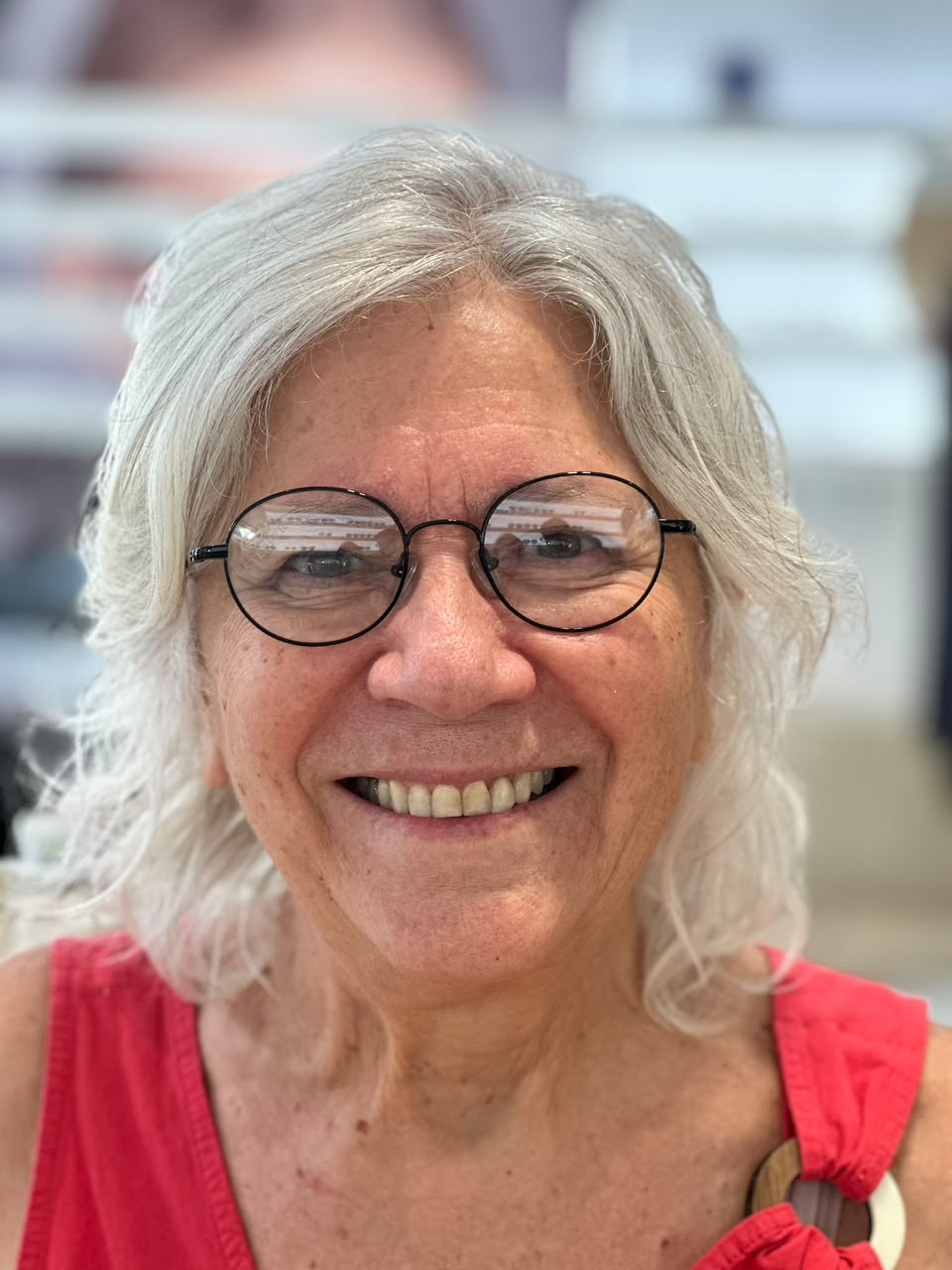
 Marly Winckler
Born 5 November 1954, Cunha Porã, Brazil · Honorary President of the International Vegetarian UnionA sociologist and translator who built, almost entirely with volunteers, the institutions through which vegetarianism entered Brazilian public life — and who then carried that work into the leadership of the world's oldest vegetarian organisation.
Marly Winckler belongs to a small group of people whose names rarely appear on the things they built. The Brazilian Vegetarian Society, the Meat Free Monday campaign that reached two million school meals a day, the Vegan Seal that organises an entire market, the first website on vegetarianism ever published in Portuguese — all of them came from her, and most of them were built without a budget, without staff and without a salary.
She was born on 5 November 1954 in Cunha Porã, a small town in the west of Santa Catarina, in southern Brazil. The region lived on subsistence farming: families grew their own food and raised their own animals. Her father, Pery Winckler, was the town's tax collector; her mother, Alice Silva Winckler, ran the local school. At fourteen she left for Passo Fundo to continue her studies, and in 1971 moved to Porto Alegre, where she began a degree in Architecture.
London, and the turn
In 1977 she went to London for two years. It was a particular moment in Brazilian history — the amnesty was taking shape, and exiles were preparing to return. She lived among political activists and among Brazilians who were about to go home, and the experience reorganised her sense of what mattered. She came back, abandoned Architecture and enrolled in Social Sciences at the Federal University of Rio Grande do Sul, graduating in 1982.
It was in that same period that she encountered Theosophical thought, which introduced her to vegetarianism. The two things arrived almost together: a widening political consciousness on one side, and on the other an ethical and spiritual reflection on the relationship between human beings and other animals. She became vegetarian in 1983.
The decade that followed took her far from home. In 1986 she helped found the Humanitarian Party in Brazil. In 1987 she lived for six months in Madras, India, inside the Theosophical tradition that had shaped her thinking. By the early 1990s she had begun to write: in 1992 she published Vegetarianismo: elementos para uma conversa sobre, a short book that was, at the time, one of very few Brazilian texts to argue the case at all.
“When I became vegetarian, in 1983, it already happened inside that atmosphere of personal and political transformation.”
Marly WincklerThe Hague, and the second turn
In 1994 she attended her first IVU World Vegetarian Congress, in The Hague. There she watched delegates argue over whether cheese and eggs belonged at a vegetarian congress — a debate that ended with IVU adopting strict vegetarianism as its dietary reference. The argument stayed with her. The following year, after the 8th International Vegan Festival in San Diego, she became vegan.
That same trip to California gave her something else: her first contact with the internet. She returned to Brazil convinced that the new medium could carry the message, and set about learning how. Knowing no other vegan who could help, she took an HTML course and built the site herself.
In 1997 she launched the Sítio Vegetariano — the first website dedicated to vegetarianism in the Portuguese language anywhere in the world — together with the Veg-Brasil and Veg-Latina email discussion lists, the first of their kind in Portuguese and in Spanish. She also began compiling a directory of vegetarian addresses, visiting restaurants and health food shops herself and recording what she found.
The lists did something the website alone could not. Vegetarians in Brazil were scattered and often isolated; the lists gave them a place to find each other. Many of the people who would later lead the Brazilian movement met there. In 1997 and 1998 she also completed a postgraduate specialisation in translation at PUC-Rio, the skill that would carry a second strand of her work for the next three decades.
Building the institutions
In 2000 she became IVU's regional representative for Latin America and the Caribbean, a role she would hold until 2016 and which connected a region with almost no presence in the organisation to its global structure.
Three years later came the decisive step. Brazil had been offered the IVU World Vegetarian Congress, but hosting it required a legal entity. In 2003 she founded the Sociedade Vegetariana Brasileira — the Brazilian Vegetarian Society — and led it as president until 2015. The congress was the trigger, but the network was already there: years of lists, meetings and correspondence had produced a community that reached nearly every state in the country. The SVB simply gave it a structure.
The congress itself, held in November 2004 at Costão do Santinho in Florianópolis, was the first IVU World Congress ever staged in Latin America. It drew participants of 32 nationalities and delegations from more than ten Latin American countries. All the food was vegan, at a time when that was still unusual even inside the movement. IVU would come to regard it as one of the best events in its history.
Its effects outlived the week. People who had been ovo-lacto-vegetarian for years left as vegans. The documentary A Carne é Fraca was launched there and went on to wide circulation. Groups, companies and projects were founded in its wake — among them Guia Vegano, now an IVU member organisation in Brazil.
Into public policy
What distinguishes Marly Winckler's work from most advocacy of the period is that she took it into government. In 2009, hearing that Ghent in Belgium had adopted an official Veggie Thursday, she telephoned Eduardo Jorge, then São Paulo's Secretary for Green and the Environment, and proposed a Brazilian equivalent. He agreed immediately. Meat Free Monday launched at Ibirapuera Park within months, making São Paulo the second city in the world to officially back such a campaign and the first to serve strictly vegetarian meals.
Two years later the campaign took its most consequential step. Working through Eduardo Jorge, she reached the Secretary of Education, Alexandre Schneider, and argued that removing meat was not enough: the meal had to be strictly vegetarian, without animal products of any kind. In 2011 one such meal a week was implemented across roughly three thousand municipal school units, reaching more than two million meals a day — the largest campaign of its kind anywhere in the world. Both secretaries eventually became vegetarians themselves.
Nothing about it was imposed by decree. The vegetarian meal entered the municipal network gradually, from 2011, and only after acceptance testing in the schools themselves: the children had to approve the menu, and they did. At that scale, a single weekday adds up — more than 430 tonnes of meat a year ceased to be served in São Paulo's municipal schools alone.
“A public policy becomes far better protected when it stops depending solely on whoever temporarily holds an office and is understood and absorbed by the institution's own technical structure.”
Marly WincklerShe had already opened a second front, and it followed exactly that reasoning. The campaign, she argued, belonged inside the Programa Município VerdeAzul — the São Paulo state scheme that assesses and certifies municipalities on their environmental performance — because a measure written into a state programme travels with the state's own machinery instead of depending on the goodwill of a single administration. She began the negotiation with Bruno Covas, then São Paulo's Secretary for the Environment and later mayor of the city, and in 2013 the campaign became one of the programme's evaluation criteria — a municipality that served the meal scored better in the state's environmental ranking.
From there it travelled on its own. Implementation in the state school network began in 2016, covering 255,000 students, and was completed the following year: by August 2017 a hundred participating municipalities had come in, and 1.7 million students were being served. On the menu was a vegetarian feijoada of black beans and vegetables, with the traditional rice and collard greens alongside.
By then the state was not merely serving the food but teaching the reasoning behind it.
“Beyond including it on the menu, the Department is also guiding schools and the students themselves on the benefits of the alternative dishes. So much so that this year the theme chosen for School Food Week is the conscious consumption of animal protein and vegetarianism. Talks on the risks of cardiovascular disease and diabetes, the environmental impact of raising animals for human consumption and the reduction of greenhouse gas emissions have been added to the programme, according to teaching cycle and region.”
São Paulo State Department of Education, 2017The same reasoning carried the campaign outside the school gates. While still president of the SVB she proposed taking it into Bom Prato, the São Paulo state network of subsidised popular restaurants, and put the idea to Roberto Tripoli, the city councillor who had long backed the campaign; he took it to the secretary responsible for the programme. Implementation began in 2015.
She brought the same method to the market. The Vegan Seal, created in 2013, certifies products rather than companies — a criterion she defined deliberately, arguing that large manufacturers could place far more animal-free products on far more shelves than a handful of fully vegan firms ever could. The Vegan Option Programme followed in 2014, working directly with restaurants, canteens and hotels to put vegan dishes on their menus and train their staff.
The law
Changing habits was never, in her view, sufficient. Institutions make rules, and rules outlast governments. In 2013 she organised the first event on animal rights ever held within the Brazilian Bar Association, at its Federal District chapter, working with Dr Ulisses Borges de Resende — a lawyer from a family that had been vegetarian for six generations. Within two years, 14 of the Bar's 27 state chapters had created their own animal rights committees.
In 2015 she organised a second event, this time at the Bar's Federal Council in Brasília. It marked the creation of the first national Special Committee for the Defence of Animal Rights, chaired by Dr Ulisses. Marly Winckler was sworn in as its Special Adviser.
Leading IVU
In 2011 she was elected to chair the International Vegetarian Union — the first Brazilian and the third woman to hold the post in an organisation founded in 1908. She served until 2014 and again from 2018 to 2025, thirteen years in total across the two terms.
Her chairmanship coincided with a deliberate shift away from the Europe-centred organisation IVU had been for most of its first century. She co-organised World VegFests across North America, Europe, Asia, Africa and Latin America, and worked to connect national societies that had often operated in isolation. She also pressed, with difficulty, for the professionalisation of an organisation that had always run on volunteers.
The most durable product of that effort is the Vegan Nutrition Guide for Adults, written by Dr Eric Slywitch and coordinated and edited by her, published in editions for healthcare professionals and for the general public. Her reasoning was consistent with everything else she had done: ethical and environmental arguments were not enough on their own, and a movement that wanted to speak to doctors, universities and health ministries had to speak in evidence.
Her reach extended beyond vegetarian congresses. At COP15 in Copenhagen in 2009 she presented The Destruction of the Amazon Rainforest by Cattle Ranching, at a point when the subject was close to taboo in climate negotiations; the talk drew an interview with The Guardian. In 2025 she handed the chairmanship to the Danish anthropologist Rune-Christoffer Dragsdahl, whom she had identified as a possible successor when they met in Berlin in 2019 and had invited to represent IVU in Europe. On 27 December 2025 the International Council conferred on her the title of Honorary President.
“I receive the title of Honorary President with deep gratitude and humility. It is an honour that I accept not as a personal recognition only, but as a tribute to the collective work of so many people who have helped build IVU over the years.”
Marly Winckler, December 2025The translator
Running in parallel to all of this is a body of work that would be a career on its own. Marly Winckler has translated more than seventy books into Portuguese, across two traditions that rarely meet.
The first is the ethical and scientific literature of the animal movement. Her 2003 translation of Peter Singer's Animal Liberation brought the founding text of the modern animal rights debate to Brazilian readers and shaped a generation of activists; she also handled the technical revision of Singer and Mason's The Ethics of What We Eat, and translated Vesanto Melina and Brenda Davis's work on plant-based nutrition. She wrote the afterword to the Brazilian edition of Gandhi's writings on vegetarianism and the preface to the Tamil edition of Will Tuttle's The World Peace Diet.
The second is Theosophical literature, the tradition that brought her to vegetarianism in the first place. She has translated and organised the Collected Writings of H. P. Blavatsky — a project running to some ten thousand pages — along with the five-volume Lúcifer series of Blavatsky's articles, and works by Annie Besant, Charles Leadbeater and Rohit Mehta.
She has never regarded the two as contradictory. Singer, she has said, forces a rational confrontation with the incoherence of caring about human suffering while ignoring animal suffering; the Theosophical tradition widens the same perception by placing all living beings inside a conception of the unity of life. Different languages, converging on the same demand.
Timeline
Honours
Legacy
Some lives are told through the posts a person held. Marly Winckler's is better told through what goes on working without her in the room: a campaign that reached the schools, a seal on supermarket shelves, animal rights committees in legal practices across a country, books that shaped generations of activists, and organisations — large and small — that were born in the wake of one week in November 2004.
She has travelled to more than sixty countries, speaks Portuguese, English and Spanish, and lives in Florianópolis, the island that hosted the congress she organised. Asked in 2025 what she would say to herself on the eve of that congress, she answered that she would say something very simple: that all the effort was going to be worth it.
- Hits: 156