


New Age concordium gazette and temperance advocate
A search on Google Books for early use of the word 'vegetarian' brings up a lot of junk with wrong dates etc. Unfortunately the earliest which appears to be genuine has 'no preview' - it is an article, apparently about the American educator Amos Bronson Alcott, in , the journal of The Concordium, Alcott House, Ham Common, London, published in 1842 - and GoogleBooks suggests it contains the V word. But as it's impossible to search it is also impossible to verify, but the link goes there anyway in case they improve it one day.
We have some confirmation in the following by H.B. Amos (1869-1946) from: The Vegetarian Messenger and Health Review of July, 1907:
"To some it may seem a small matter to spend time in trying to "track down" the actual authorship of the word "vegetarian," and, in one sense, it is of very little moment, it is true. At the same time, as the word has entered so definitely into the current coin of the language of the realm, it is only fair that the matter should be followed up and honour given where it may be due - if it can be done. But having said this, I must confess that though I have spent considerable time recently in ransacking in the British Museum the literature of the period, I have been unable to carry the word further back than 1842. This, however, is five years before the formation of the Vegetarian Society. On the occasion referred to it appears in the Healthian, for April, a magazine published monthly, and dealing with "Human Physiology, Diet and Regimen." The word is used in a perfectly formal and natural manner, so that it is evident it was in regular use before that date."
The Healthian was published by The Concordium, Alcott House, from 1842-3. It was then replaced by the New Age for 1843-4:
New Age concordium gazette and temperance advocate
Volume 1, 1843/4 published by Alcott House, Ham Common, London
p.64 - July 1843 issue:
"Like yourselves, I am an epicure, a vegetarian [this implies that the word was already familiar, at least readers of the Alcott House journal]
p.143 - December 1843 issue: The Philanthropist Howard : A Hydropath. And Vegetarian. [refers to John Howard, prison reformer] "He was singular in many of the common habits of life; for instance, he preferred damp sheets, linen, and clothes, to dry ones; and, both rising and going to bed, swathed himself with coarse towels, dipped in the coldest water he could get. In that state he remained half an hour, and then threw them off, freshened and invigorated, as he said, beyond measure. He never put on a great coat in the coldest countries, nor had been a minute under or over time of an appointment,so far as it depended on himself, for six and twenty years. He never continued at a place, or with a person, a single day beyond the period prefixed for going, in his whole life; and he had not, the last sixteen years of his existence, ate any fish, flesh, or fowl, nor sat down to his simple fare of tea, milk, and rusks all that time."—(From the Ladies Magazine, 1792.)
[the word vegetarian was only used in 1843, not 1792!]
p.237 June 1844 issue: "To our vegetarian friends it may be interesting to hear the remarks on the insalubrity of the chief settlement at Hong Kong,..."
The Mirror of Literature, Amusement, and Instruction
Vol.II, No.21, Saturday November 18, 1843. London.
p.337 - Reviews: Flowers and Fruits; or Poetry, Philosophy, and Science. By James Elmslie Duncan. [Other sources, below, show that Duncan was a poet for the Concordium, Alcott House, and by 1848 became its secretary.]
.... He is an advocate for vegetable diet. For this he stands up manfully, and as the best interests of society, if he is right, are connected with the adoption of his views on the subject, it may be well to let him speak for himself. After rather an elaborate description of " The breathing, moving wonder—man," he tells us—
" The thousands who have adopted the vegetable and water diet find themselves the better in health for having so done; we are, therefore, warranted in supposing their longevity will be the greater for it. And the greater portion of those celebrated for their extraordinary age have all been, more or less, more than usually temperate and simple in their diet, have approached, more or less, more than usual, in fact, to the vegetarian diet. Thousands of cases in point might be brought forward, but let the following suffice:—Jenkins and Parr were both exceedingly temperate and simple in their diet, they were almost strict vegetarians and ' teetotalers.' And it is well known that it was the opinion of the medical men of the times, from & post-mortem examination of his body, that the latter would have lived much longer than he really did, had he not been absolutely killed by having his own wonted simple diet changed for that of the Court of King Charles II. [continues at some length, referring to 'vegetable diet' etc., but with no further use of 'vegetarian'.]
- link to full text on Google Books
- . By James Elmzlie (sic) Duncan [link to Google Books - but 'no preview']
- for Duncan see George Jacob Hollyoake 'History of Co-operation' 1875 [link to complete book on gerald-massey.org.uk], C.XIV: "The Concordium had a poet, James Elmslie Duncan, a young enthusiast, who published a Morning Star in Whitechapel, where here it was much needed." [also brief extract on Google Books ]
- - and 'Story of a Year, 1848' [brief extract on Google Books] by Raymond William Postgate, 1955: "Some ignobly left the Concordium and put on warm pants or stays. James Elmslie Duncan, their secretary, got himself locked in jail for holding up the traffic in Bishopsgate by reciting his own revolutionary poems; ..."
The Board of Health & Longevity, or Hydropathy for the People
London, 1845
by W. Horsell, V.D.M., I.O.R
p.62: 'vegetarian Brahmins';
p.98: '... He is a vegetarian. General T. Sheldon of the United States, also a vegetarian..."
pp.250-252: references in the index to vegetarians: Daniel (Biblical), Dr. (Benjamin)
Franklin; Dr. Knight; Gen. Sheldon
William Horsell was the manager of the Hydropathic Hospital in Ramsgate, Kent. He published a journal - The Truth Tester - which in 1847 carried the first proposal for a Vegetarian Society. This was followed up by Wm. Oldham at Alcott House who arranged the first meeting.
The Metropolitan Magazine
Vol. XLVIII, January to April, 1846, London
THE VEGETARIAN
OR,
A VISIT TO AUNT PRIMITIVE.
BY FANNY E, LACY.
COMPANION TO A " A SKETCH OF A CHARACTER" IN NUMBER CLIXI. OF THE "METROPOLITAN" FOR APRIL, 1846.
"A vegetable diet affords the same support as animal food, with the important advantage of preventing plethora."—Dr. Iteece'a Medical Guide.
" Now I do entreat, Walter," said my mother, as I was taking my departure for a gay sojourn in London,—" I do beg and entreat, that you will not leave town without paying a visit to your Aunt Primitive. She does not live exactly in the metropolis, to be sure: she is still at her pretty little retirement, Evergreen Lodge. Only do make a point of calling upon her, my dear boy."
" Oh, yes! to dine upon cold cabbages and water-gruel," was my jocose reply. " I dare say, indeed."
" Nay, nay," chimed in my father, " you may find yourself mistaken there, Wal. Mrs. Primitive's hospitality has never been questioned, I believe : and though, from choice, she has for many years been a vegetarian, she does not insist upon her visitors following her example."
[a long story follows over several pages with many uses of the word 'vegetarian']
The Truth seeker in literature, philosophy, and religionVolume 2, London, 1846
p.99: By the way, the stolid critics who elevate the Bible into an inspired Culinary Composition, and convert the comparisons and conceptions of the Jewish Sages into the absolute truth of God, have here quite as good an argument against vegetarian diet, as for vinous drink! The Jewish mind represented Wisdom as 'killing her beasts': therefore, the butchering system must be absolutely best!! What says John Smith to this?
The Reasoner: and 'Herald of progress'Vol.1 London, June 1846
p.23 (from a long article on Shelley) It is somewhat diverting to observe the strange premises seized on by various enthusiasts in support of their eccentric views. The Nairs were Shelley's models of virtue or civilization; Wild Peter was Rousseau's ' pure Child of Nature;' and Lord Monboado's was a true vegetarian. Shelley too, by the by, wag a vegetable theorist, but we are disposed to let his soups and jellies alone; our prejudice in favour of roast meat is very stubborn after reading all he has written.
Howitt's journal of literature and popular progress
Volume 1, London, June 12, 1847 By William Howitt, Mary Botham Howitt
p.336: Co-operative Excursion.—On Whit-Monday [late May] a uumber of the members and friends of the Co-operative League, being desirous of connecting rational enjoyment with the spread of their principles, determined to spend the day together, in a rural excursion to the vegetarian establishment, Alcott House, Ham Common, thereto commune together on the advantages of cooperation. Those who were able, started early in the morning, and the remainder of the friends continued to arrive during the day. A vegetable dinner, consisting of several kinds of pies, puddings, and fruits, was provided by the proprietors of Alcott House, for such as chose to partake of it, at a trifling cost, and was the subject of considerable amusement; others of the friends whose fleshly appetites could not brook so simple an entert ninment, formed pic-nic parties, or betook themselves to neighbouring places of accommodation. At half-past two o'clock, according to agreement, a co-operative meeting was held on the lawn adjoining the house, Mr. Hawkins presiding. Mr. Lane addressed the friends with his usual ability, pointing out the hindrances which existed to the complete success of the co-operative principle ; dwelling on the necessity of co-operation being based on the religious sentiment, and contended that it ought not to be regarded solely, or even principally, in a selfish point of view, as a means of procuring greater quantities of food or clothing; but as an advance towards a higher and purer condition of life, and as being more in accordance with the laws of the Creator; he also enforced his views of the superiority of vegetable diet; arguing against the use of flesh, and the slaying of animals, as tending to brutalise man's nature, and requiring large appropriations of the soil for rearing animals, which should be cultivated to furnish food for man. The cause of co-operation was also successfully pleaded by other friends in speeches abounding with sound argument, persuasive appeals, and glowing contrasts of the evils, misery, and degradation of the present system of antagonism and competition, with the improved condition of the human race in that " good time coming" when co-operation shall have done its perfect work. The meeting lasted an hour and a half, and the friends then separated to enjoy the country. Tea was served on the lawn, and dancing filled up the remaining time. On the way home the spirit of joyous hilarity was not to lie restrained, aud healthy and invigorating songs, aud spirited recitations, followed each other in quick succession. The day was altogether of the most interesting character, and gave general satisfaction. It is intended to hnve similar excursions through the summer, and as drinking and smoking will be excluded, it is hoped that they will prove not only recreative, but also educational.
In early 1847, the Truth Tester, published by William Horsell at the Hydropathic Hospital in Ransgate, Kent, carried a letter proposing the creation of a Vegetarian Society. This was followed up by Wm. Oldham, manager of the Concordium, Alcott House, who arranged the first meeting at Alcott House on Thursday July 8, 1847.
The meeting was adjourned to September 30 at Ramsgate, where The Vegetarian Society was founded. Full details of all the above at www.ivu.org/congress/1847
Punch magazine, 1848, Vol XIV, p.182
THE VEGETARIAN MOVEMENT.
When we noticed, a week or two ago, a banquet of vegetables, we were not aware that a great Vegetarian Movement was going on, with a vegetarian press, a vegetarian society, a vegetarian boarding-house, a vegetarian school, two or three vegetarian hotels, a vegetarian Life Insurance Office, vegetarian letter-paper, vegetarian pens, vegetarian wafers, and vegetarian envelopes.
The Vegetarian Advocate has replied to our article on the late vegetarian banquet, and we must confess that, notwithstanding the very cholera-inducing diet on which the members of the sect exist, the answer is by no means of a choleric character. The Vegetarian Advocate has a delicious vegetable leader, with two or three columns of provincial intelligence, showing the spread of vegetarian principles. There are vegetarian missionaries going about the country inculcating the doctrine of peas and potatoes; and there is a talk of a vegetarian dining-room, where there is to be nothing to eat but potatoes, plain and mashed, with puddings and pies in all their tempting variety.
We understand a prize is to be given for the quickest demolition of the largest quantity of turnips; and a silver medal will be awarded to the vegetarian who will dispose of one hundred heads of celery with the utmost celerity. We sincerely hope the puddings will not get into the heads of our vegetarian friends, and render them pudding-headed; but they are evidently in earnest; and, if we are disposed to laugh at them for their excessive indulgence in rice, we suspect that, Ilisum teneatis, amid, will be the only reply they will make to us.
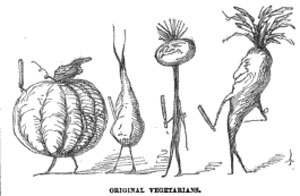
- link to the original volume on Google Books - this appears to be a combined volume for 1848, the item must have appreared early in the year for the follow-up below.
Holden's Dollar Magazine, New York, July 1848, Vol.II, No.1
p.260: a satirical poem about '...the transcendental "Vegetarian" Alcott' (other satirical comments on later pages)
p.763: The vegetable eaters, who, a few years since, made so much noise amongst us, being stirred up by Dr. Graham, have lately sprouted up in great numbers in England. They are there called Vegetarians, and they have become so numerous that they have a representative in Parliament, and have recently been having vegerable banquets all over England ; and we should not be astonished if, by and by, we hear talk of the roast potatoes, instead of the roast beef od old England. [the entire section of Punch, above, is then quoted, minus the cartoon, followed by another brief satirical comment.]
- Hits: 1563