


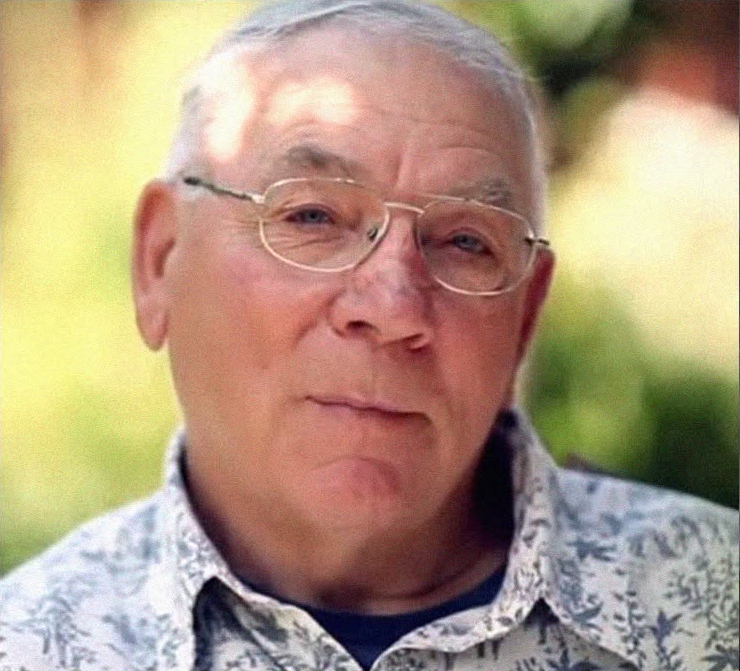
 Howard Lyman
17 September 1938 – October 2026 · Montana, United States · President of the International Vegetarian Union, 1996–1999A fourth-generation Montana cattle rancher who ran seven thousand head on chemically farmed land, lost the use of his legs, and came back to spend the rest of his life telling the industry he had belonged to what it was doing. He led IVU through the years in which a beef lawsuit made the vegetarian argument front-page news.
Howard Lyman was the witness the other side could not dismiss. Every argument he made about industrial animal agriculture, he had first made true of himself: the chemicals, the feedlot, the seven thousand cattle, the soil he said he had turned into something that looked like asbestos. When he told an American television audience in 1996 that the practice of feeding ground-up cattle back to cattle could bring mad cow disease to the United States, a group of Texas cattlemen sued him. He was, at that moment, the newly elected President of the International Vegetarian Union.
A fourth-generation rancher
He was born Howard Fenn Lyman on 17 September 1938 in Great Falls, Montana, the fourth generation of his family on the same land. He took a degree in agriculture at Montana State University in 1961, served two years in the US Army and went back to the farm.
What he did there was what American agriculture did everywhere in those decades: he made it bigger. Dairy, hogs, registered Herefords, poultry, range cattle, feedlot beef, veal, grain, silage and hay; thousands of acres, some seven thousand head of cattle, up to thirty employees and a turnover of several million dollars. The inputs were chemical and the animals were confined, and both of those things were, at the time, simply what good farming meant.
He later described watching the ground itself change under that regime — a living soil becoming, in his words, sterile and saturated, a mono-cultural floor that no longer behaved like earth.
One chance in a million
In 1979 a tumour on his spinal cord left him paralysed from the waist down. The surgeons gave him, as he told it, one chance in a million of ever walking again. Waiting for the operation, he made himself a promise: if he came out of it on his feet, he would farm without the chemicals and he would say what he had seen.
The operation took twelve hours. He walked out of the hospital. He kept the promise, turned the land organic, and in 1982 ran for Congress in Montana, losing by under four per cent. In 1983 he sold the farm — keeping his great-grandfather’s homestead, which he made a wildlife sanctuary — and went to Washington as a lobbyist for the National Farmers Union, working for small farmers in financial trouble work he credited with helping to secure the national organic standards legislation.
What he was putting on his fork
The second change was to his own plate, and it came late. He weighed around three hundred pounds, his blood pressure was high and his cholesterol was over three hundred. From about 1990 he stopped eating meat, and within roughly a year he was vegan. He lost more than a hundred pounds; the blood pressure came down; the cholesterol fell to 135.
“The reason I’m alive is because I cared enough to look at what I was putting on my fork.”
Howard Lyman, European Vegetarian Congress, 1997By 1992 he was executive director of the international Beyond Beef campaign, where he put ten thousand volunteers on the street with leaflets. He founded Voice For A Viable Future, directed the Humane Society of the United States’ Eating With Conscience campaign, and later served as president of EarthSave International. The argument he carried was never only about animals: it was about soil, water, energy and the people who farm. He liked to point out that a calorie of feedlot beef costs more than seventy calories of energy to produce.
A broadcast and a lawsuit
On 16 April 1996 an episode of The Oprah Winfrey Show called “Dangerous Food” went out across the United States. Lyman explained on it that cattle were still being fed the rendered remains of other cattle, and that this was the route by which BSE had moved through British herds. Winfrey replied that it had stopped her cold from eating another burger. Cattle futures fell, and the plaintiffs would later call it the “Oprah Crash”.
On 28 May 1996 Texas cattle feeders led by Paul Engler and Cactus Feeders sued Winfrey, her production company and Lyman for more than ten million dollars, using a Texas statute against the disparagement of perishable food — one of the “veggie libel” laws that several American states had passed in the early 1990s. The trial was held in Amarillo, in the middle of cattle country. In February 1998 the jury found for the defendants, and in February 2000 the Fifth Circuit upheld the verdict, holding that what Lyman had said rested on accurate facts and was not knowingly false.
It was the first serious test of those laws, and it failed in the one place the industry had chosen. For the vegetarian movement it did something no campaign had managed: it put the feeding practices of the beef industry into every newspaper in the country, for two years, at the industry’s own expense.
President of IVU
Three months after the broadcast, on 2 August 1996, Howard Lyman took office as President of the International Vegetarian Union at the 32nd World Vegetarian Congress in Johnstown, Pennsylvania — a congress that drew close to eight hundred delegates from twenty-one countries. He succeeded Surendra M. Mehta; Maxwell G. Lee became Deputy President and Francisco Martin Honorary General Secretary.
IVU was then in its eighty-ninth year, a federation of national societies spread across five continents, and it had just acquired a president who was being sued over what he had said on television. He used the position the way he used every platform he was given. His first message to the membership as president set out the case in the terms he always preferred — health, animals, forests, soil, water, and the arithmetic of feeding a growing world — and ended on the instruction he repeated everywhere.
“Diet is the key to our future. We must walk our talk.”
Howard Lyman, From the President, IVU News, 1996In September 1997 he spoke as IVU President at the European Vegetarian Congress in Bussolengo, Italy, where he gave the account of the ranch, the tumour and the fork that became the core of his public life, and where he set out his argument that change had to be built by producers and consumers together rather than waited for from governments. His presidency ran to the 33rd World Vegetarian Congress, held in Thailand from 4 to 10 January 1999. He sat on its International Council from 1996 to 1999, and was also named a Patron and a Fellow of the Union.
Mad Cowboy
The book gave him the name he kept. Mad Cowboy appeared in 1998, in the middle of the litigation, and turned a court case into an argument anyone could follow; No More Bull! followed in 2005. A documentary of the same name told his story, and he appeared in McLibel, Meat the Truth, Peaceable Kingdom, Vegucated and Cowspiracy, the film that introduced him to a generation born after the lawsuit.
He was given the Peace Abbey Courage of Conscience Award in April 1997 and entered the Vegetarian Hall of Fame on 3 August 2002, at the North American Vegetarian Society’s Summerfest — in Johnstown, the town where he had become president of IVU six years earlier. He went on lecturing into his eighties, latterly from Ellensburg, Washington, where he lived with his wife, Willow Jeanne Lyman.
Timeline
Legacy
Movements are usually argued by people who were always on the right side of them. Howard Lyman was not. He had done the thing he spent thirty years describing, at scale, and that is why the description landed: when he said that feeding cattle to cattle was reckless, or that the soil was dying under chemical agriculture, he was not reporting someone else’s industry. The cattlemen understood this perfectly, which is why they sued him rather than ignore him, and why losing cost them more than silence would have.
For IVU he arrived at exactly the right moment and brought something the organisation had never had: a president whose name was in the American press throughout his term, for the best possible reason. He summed up his own position in six words at the congress that elected him, and never found a reason to revise them.
“We are either part of the problem or part of the solution.”
Howard Lyman, World Vegetarian Congress, 1996- Hits: 91